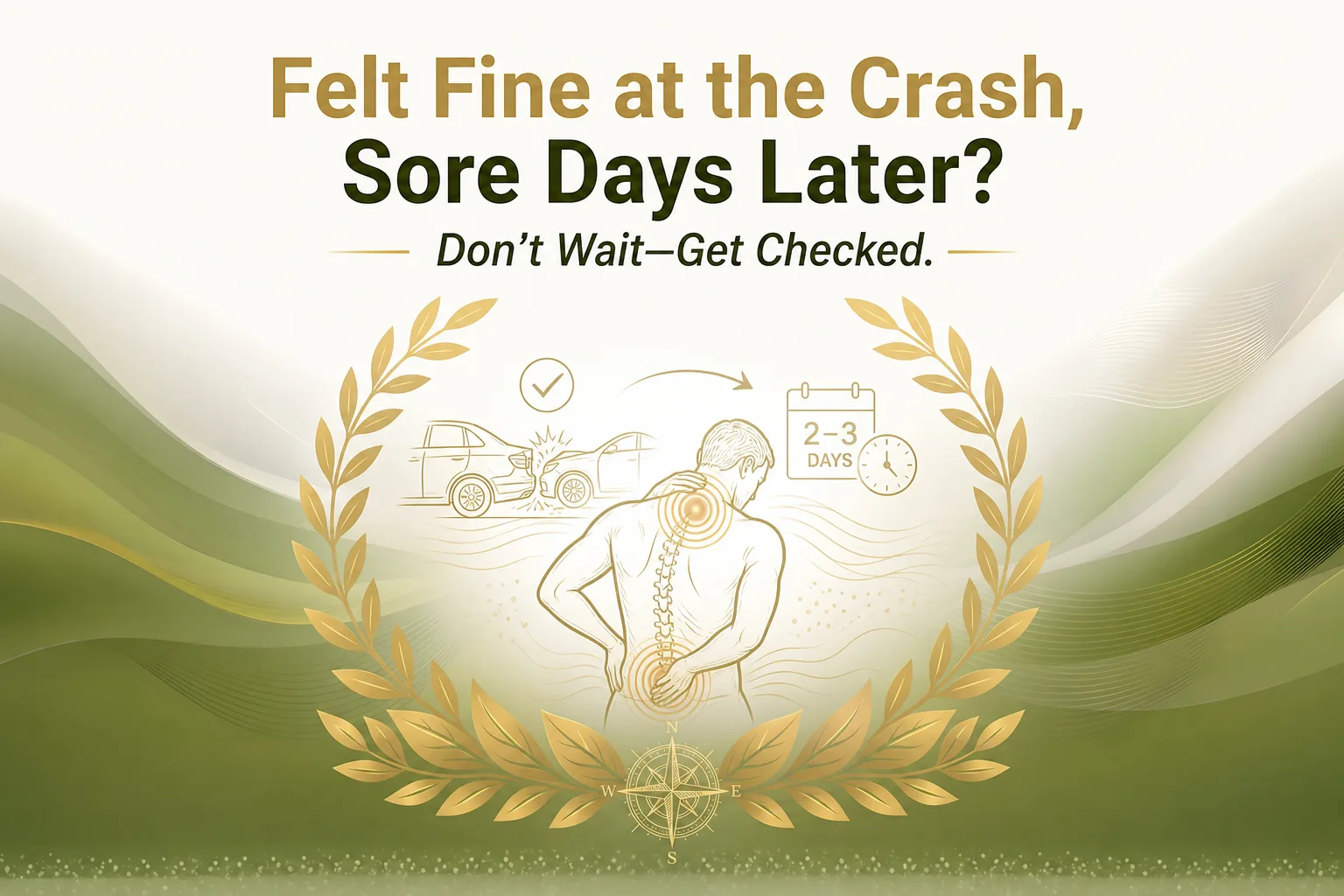
Back hurts days after car accident should I get checked?
Yes, get checked. Feeling fine at the scene and stiff or sore two or three days later is one of the most common patterns we see at intake after a collision, and it is not a sign you are imagining things or being dramatic. A short evaluation in that window tells you whether this is ordinary soft tissue soreness that will settle on its own, or something that needs closer attention — before you sign anything or decide to tough it out.
Felt fine at the scene, sore three days later — is that normal?
If you walked away from the crash, told the officer you were fine, waved off the ambulance and drove yourself home — and then woke up on the second or third morning with a neck that will not turn far enough to check your blind spot, a low back that catches when you stand up from the couch, or an odd tingling running down one arm — you are describing something we hear at the front desk most weeks.
The wording is almost always the same, too. “I wasn’t hurt, but my back is more stiff than usual.” “I felt fine at the time, then the next day I had some pain and numbness in my arm.” “It was barely a tap in the Publix lot, I don’t know why I feel like this.” In online forums where people compare notes after a wreck, the same sequence shows up again and again: nothing at the roadside, then stiffness or numbness arriving a day or three later — sometimes while an adjuster is already calling to wrap the claim up.
So here is the straight answer before anything else: the delay is normal, and it is worth being looked at. Not because every late-arriving ache is serious — most of what we see in that window is soft tissue strain that improves steadily with time and sensible care — but because you genuinely cannot tell the difference from your kitchen table on day three. And the decisions sitting in front of you right now, including whether to respond to that adjuster and whether to go back to your usual workouts, all get easier with an actual examination behind them.
The rest of this page covers why pain lags, which symptoms mean urgent care instead, what an evaluation at this stage actually looks for, and why what gets written down in the first week matters more than most people expect.
What’s happening in your body in the days after a crash you walked away from
At the moment of impact, your body does what it is built to do under sudden threat: it floods you with stress hormones, sharpens your focus, and turns down your sense of pain. That is why people climb out of a mangled car and immediately start taking photos, exchanging insurance details, and worrying about whether their kid is late for practice. You are not calm because nothing happened. You are calm because your nervous system is busy running the emergency.
When that response winds down over the following hours, two slower processes take over. First, the muscles around any strained joint or ligament start to tighten protectively — a guarding reflex. It is useful in principle, like a splint you did not ask for, but it also limits motion and creates its own deep, dull ache. Second, inflammation builds in strained tissue, and inflammation is not instant. It accumulates, which is why soreness often peaks after you have slept on it and then sat through a full workday at a desk or behind the wheel on I-575.
That is the honest reason the third morning is frequently the worst one. You went still for eight hours, the guarding set in while you slept, and then you asked a stiff neck and a tight low back to do a normal day.
It is also why the state of your bumper is a poor predictor of how you feel. A vehicle is designed to absorb and redistribute energy; a bumper that barely scuffed may have transferred more of that energy through the frame and into the people inside. What tends to matter more is the direction of the impact, whether you saw it coming and had time to brace, where your head was turned at the moment of contact, and how your headrest was positioned relative to the back of your skull. A driver who was looking over their right shoulder, backing out slowly, and got tapped from the side can end up more symptomatic than someone whose car needed a new quarter panel.
“I only got tapped” is a description of the car. It is not reassurance about your neck.
Symptoms that mean urgent care or the ER, not a chiropractor
Some symptoms after a collision are not a wait-and-see situation, and a chiropractic office is not the right first stop for them. If you have any of the following, go to an emergency department or call your physician now — and if something feels severe or frightening, call 911 rather than driving yourself.
- Numbness, tingling or weakness that is spreading, worsening, or affecting both arms or both legs
- Loss of grip strength, dropping things, or trouble lifting your foot when you walk
- Any change in bowel or bladder control, or numbness through the groin or inner thighs
- A severe headache, a headache that keeps escalating, confusion, slurred speech, vision changes, repeated vomiting, or loss of consciousness at any point
- Chest pain, shortness of breath, or abdominal pain and bruising, particularly across a seatbelt line
- Pain that is dramatically and rapidly worse rather than slowly settling, or that wakes you repeatedly from sleep
- Fever alongside new spinal pain
When someone calls or arrives at our Woodstock office describing any of these, we say so plainly and send them where they need to go. That is not us passing the buck — it is the difference between a condition that needs imaging or an emergency physician and one that is appropriate for conservative musculoskeletal care.
It also works the other way. If you were seen at the ER the night of the crash, told nothing is broken, given something for the pain and discharged, that is good news about fractures and internal injury. It is not the same as an assessment of how your neck, mid-back and low back are moving a week later. Plenty of people need both.
Back hurts days after car accident should I get checked, or will it pass?
This is the real question, and the real objection underneath it usually sounds like: it is probably nothing, I do not want to make a fuss, and I do not want to get roped into three months of appointments I did not ask for.
Fair. So let’s be clear about what “getting checked” means here. It means an evaluation and an honest read on what we find. Sometimes that read is: this looks like a straightforward strain, here is what to do at home, here is roughly what the next couple of weeks should look like, and come back if it is not tracking that way. We would far rather tell you that than invent a reason to see you twice a week.
The argument for doing it now rather than later is mostly about information. A baseline taken on day four — how far your neck rotates, which side is restricted, whether there is nerve irritation, where you are guarding — is a measurement. A reconstruction attempted on day thirty, after a month of compensating, is a guess. If you improve, that baseline shows how far you came. If you do not, it gives us something to compare against instead of starting from scratch while you are at your worst.
And no, an evaluation is not a commitment to a long treatment plan. This is worth saying because high-volume accident clinics exist, and some of them sign people up for a fixed schedule of visits before anyone has laid hands on them. That is not how a family practice works. You can be examined, hear what we found, take the home guidance, and decide nothing else. Plenty of people do exactly that.
It is also not too late. Being seen several days or a couple of weeks after a crash is normal — that is precisely when delayed symptoms bring people in. Earlier gives you more useful information, but “I waited a week” does not disqualify you from being evaluated or cared for.
What an evaluation three to ten days after a crash actually looks for
An exam in this specific window is different from a routine new-patient visit for an everyday backache, because we are reconstructing a mechanical event and then checking what it left behind.
We start with the crash itself, in detail that sometimes surprises people. Which direction did the impact come from? Were you stopped or moving? Did you see it coming in the mirror, or were you looking at the radio? Was your head turned, and which way? Where was the headrest relative to the back of your head — level with your skull, or down around your neck? Were you belted, did the airbag deploy, did you brace against the wheel or the floor? Did you hit your head on anything? A side impact while your head was rotated loads the neck very differently than a straight rear-ender with your head square against the restraint, and that shapes what we examine most closely.
Then we look at how you actually move. Range of motion in the neck and mid-back, measured in each direction and compared side to side, because asymmetry often tells us more than the raw number. Where motion stops, and whether it stops because of pain, stiffness or guarding. How your shoulders and rib cage move when you breathe and reach. Whether your low back and hips are sharing load evenly when you bend, stand and sit.
We palpate — hands on — for muscle guarding, tenderness and joint restriction, and we note where those findings sit relative to the direction of the impact. If you have tingling, numbness or weakness anywhere, we add an orthopedic and neurological screen: reflexes, sensation, strength testing, nerve tension tests.
Throughout, we are also trying to rule things out. Signs that point toward fracture, instability, concussion or significant nerve involvement are signs to stop and refer, not to adjust. When the picture calls for imaging or a conversation with your physician first, we say so before any hands-on care begins. Starting carefully is part of doing this properly, especially in the first two weeks after a collision.
Why what gets written down in week one matters more than people expect
Most people think of a chiropractic visit as something that happens to their body. After a crash, it is also something that happens on paper, and the paper has a longer life than the appointment.
A contemporaneous record is simply a written account of what was found, when it was found, by someone who examined you. For a delayed-onset case it typically includes the crash details you described, the date your symptoms appeared, measured range of motion, what was tender or restricted and on which side, the results of any neurological screening, and — this part gets undervalued — your functional limits. Not just “neck pain,” but that you cannot turn far enough to merge comfortably, cannot sit through a ninety-minute meeting without shifting, cannot lift your two-year-old out of the car seat with your right arm. Those specifics are what make a record meaningful later, to you and to anyone else reading it.
The practical reason timing matters is simple. A long, unexplained gap between the crash date and the first examination invites an obvious question: then what caused it? Six weeks of ordinary life sits in that gap — a move, a gym session, yard work. Being seen while the connection is still clear removes a lot of ambiguity that nobody can recover afterward.
What we will not do is inflate it. If findings are mild, the notes say mild. If your rotation is only modestly restricted and improving, that is what gets recorded. Accurate documentation is worth far more than dramatic documentation, and a record that overstates the picture tends to undermine itself.
If you have a physician coordinating your care, or an attorney handling the claim, we provide records on your request. We do not give legal advice and we do not have a preferred attorney to steer you toward — those are your decisions, and we would rather keep our role clean: examine you, treat you appropriately, write down accurately what we found.
Before you settle: what signing assumes about how you’ll feel next month
Here is the situation we hear about more than you would think. The crash was a week ago. The adjuster has been pleasant and quick, there is an offer on the table that covers the car and a bit more, and signing would make the whole thing go away before the weekend. Meanwhile, your neck is still tight and your fingers went numb twice yesterday.
Speaking generally and not as legal advice: a settlement for bodily injury usually involves signing a release, and a release typically closes that part of the claim for good. If symptoms linger, worsen, or if something shows up later that turns out to be related, you generally cannot go back and reopen it. You are not just being paid for how you feel today — you are making a prediction about how you will feel next month and the month after.
An adjuster’s timeline is a business timeline. It is built around closing files efficiently, and there is nothing sinister about that. But it is not a medical timeline, and the two are not obliged to match. Soft tissue injuries commonly need a few weeks to show whether they are resolving steadily or settling into something more stubborn, and that information does not exist yet on day seven.
So the sequence we would suggest is unglamorous: get evaluated first, so you know what you are dealing with. Give it a little time to declare itself. And for anything beyond a straightforward property-damage claim, talk to an attorney before you respond to a settlement offer. You are not obligated to decide quickly, and knowing your own body before you sign is not a tactic — it is just sensible.
Driving, desk work, and sleep in the first two weeks
You still have to get to work, merge onto 575, and get a kid into a car seat. A few practical notes for the stretch while things calm down.
Take the driving piece seriously. A neck that will not rotate makes a shoulder check genuinely unsafe, and people compensate by relying on mirrors alone. If you cannot turn far enough to see your blind spot, limit driving, adjust your mirrors wider, and ask for help with longer trips until rotation improves.
At a desk, pace rather than choosing between total rest and pushing through. Both extremes tend to backfire: complete stillness stiffens you further, and powering through a normal workload usually sets you back a day. Get up every half hour, walk the hallway, and bring your screen to eye level so your neck is not held forward for hours.
For sleep, aim to keep your head level with your spine — a pillow that fills the gap at your neck without propping your head up, and a pillow between or under the knees if your low back is sore. Short, frequent walks usually beat long ones early on.
Ice tends to suit the first few days when things feel hot and irritated; gentle heat often feels better once the sharp phase passes. Massage therapy and active therapy fit well as recovery progresses, supporting comfort and restoring movement rather than fixing anything on their own.
How we’d approach your first few weeks at Ribley
For a delayed-onset case, a realistic plan starts with a thorough evaluation and a short, defined stretch of care — then a re-evaluation to see what actually changed. We do not book people out for months in advance based on an accident date, because nobody can honestly know on day four what week nine will require.
Goals get framed around things you can notice: turning your head far enough to drive confidently, sitting through a workday without bracing, sleeping through the night, getting back to the trail or the gym at your normal pace. Most straightforward strains improve meaningfully over a few weeks, though recovery is rarely a straight line — and if yours is not tracking the way it should, that is a reason to reassess or refer, not to repeat the same thing harder. We coordinate with your physician when that makes sense and we make no promises about outcomes.
When you come in, bring the crash date and any accident report, your insurance information, notes from the ER or urgent care if you went, and a list of what hurts and what it is stopping you from doing. Call the Woodstock office and tell them it was a recent accident so we can get you seen promptly.