Herniated Disc vs. Bulging Disc: What Woodstock Patients Need to Know Before Treatment
Written on . Posted in Chiropractic Care.
Back pain can feel much more serious after you read an MRI report. Terms such as “disc bulge,” “protrusion,” “extrusion,” and “herniation” sound alarming, especially when the report also mentions nerve contact or narrowing around the spinal canal. However, an imaging label does not tell the entire story.
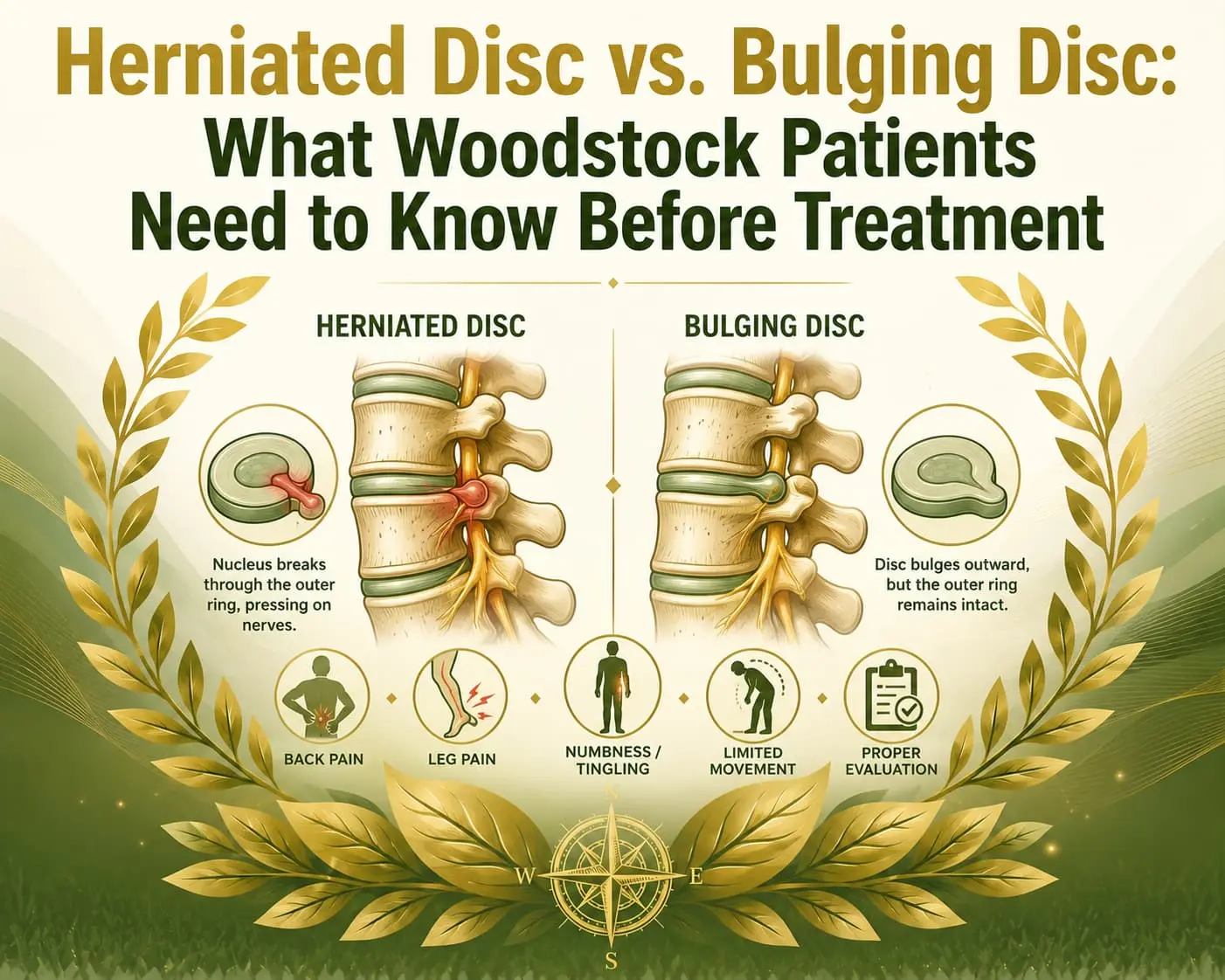
The basic difference between a herniated disc and a bulging disc involves the shape and location of displaced disc tissue. A bulging disc generally describes a broader change around the outer contour of the disc. A herniated disc describes a more localized displacement of disc material. Standardized spine terminology also makes an important point: the appearance of a disc does not automatically explain a patient’s symptoms or determine which treatment is necessary.
That distinction matters for Woodstock patients deciding what to do next. A small herniated disc can cause significant leg pain if it irritates a nerve, while a larger bulging disc may cause no symptoms at all. The right treatment should be based on your symptoms, neurological findings, daily limitations, health history, and imaging when imaging is medically appropriate.
This article explains how bulging and herniated discs differ, what symptoms require prompt attention, how disc problems are evaluated, and where chiropractic care may fit within a responsible treatment plan.
The Simple Difference Between a Bulging Disc and a Herniated Disc
A bulging disc is a broad outward change in the disc’s normal contour. Instead of one small section extending beyond its usual boundary, a wider portion of the disc projects outward. “Bulging” describes the shape seen on imaging. It does not, by itself, prove that the disc is painful, that a nerve is compressed, or that the patient needs a specific treatment.
A herniated disc is a localized displacement of disc material beyond its normal space. Depending on its shape, a radiologist may describe the herniation as a protrusion or extrusion. A sequestration is a type of extrusion in which a piece of displaced disc material has separated from the parent disc. These terms help healthcare providers describe what they see, but the terminology must still be compared with the patient’s symptoms and examination.
In everyday conversations, “bulging disc,” “herniated disc,” “slipped disc,” and “ruptured disc” are sometimes used interchangeably. Even medical websites and reports may use slightly different wording. That is why it is useful to ask your provider to show you where the affected disc is located, whether it contacts a nerve, and whether the finding matches your symptoms.
The most important takeaway is that a herniated disc is not automatically more painful than a bulging disc. Location, inflammation, nerve involvement, spinal canal space, and your individual response all influence how the condition feels.
How the Discs in Your Spine Work
Your spine is made of stacked bones called vertebrae. Between most of these vertebrae are intervertebral discs that provide cushioning and help distribute stress as you sit, walk, lift, twist, and exercise.
Each disc has two main components. The annulus fibrosus is the stronger outer ring. The nucleus pulposus is the softer center. Together, these structures help the disc absorb force while allowing controlled spinal movement.
Discs change over time. They can gradually lose water content, flexibility, and height as part of age-related degeneration. Repetitive lifting, frequent bending and twisting, prolonged sitting, physically demanding work, smoking, and traumatic injuries may also contribute to disc problems. Improperly lifting an object while twisting can place particularly high stress on the lower back.
A disc problem does not always begin with a dramatic injury. Some Woodstock patients notice symptoms after moving furniture, doing yard work, exercising, or lifting a child. Others develop pain gradually after long periods of sitting, repetitive job duties, or years of normal wear. A relatively minor movement may trigger symptoms when a disc has already become less flexible.
What Is a Bulging Disc?
A bulging disc occurs when a broad portion of the disc extends beyond its expected boundary. It is commonly associated with degenerative changes, although the word “bulge” only describes appearance and should not be treated as a complete diagnosis.
A bulging disc may not cause any discomfort. It becomes more clinically important when its position contributes to narrowing around a nerve root, irritates surrounding tissues, or occurs alongside other changes such as arthritis, thickened ligaments, or spinal stenosis.
Symptoms can also come from structures near the disc. Muscles, spinal joints, ligaments, the sacroiliac joints, and hips can produce pain that feels similar to disc pain. This is one reason an examination is necessary before attributing every case of back pain to a finding on an MRI.
It is also incorrect to assume that a bulging disc is always a minor problem. A broad bulge in a naturally narrow spinal canal may affect a nerve, while another person can have a noticeable bulge without pain, numbness, or weakness. Imaging must be interpreted in context.
What Is a Herniated Disc?
A herniated disc occurs when disc material moves beyond its normal space in a localized area. The displacement may develop gradually as the disc degenerates or occur more suddenly after a forceful strain, fall, twisting injury, or lifting incident.
A herniation can cause symptoms in two related ways. First, the displaced material may mechanically press against a nearby nerve root. Second, disc material can contribute to inflammation and chemical irritation around the nerve. This combination can produce pain, tingling, numbness, burning, or weakness along the path of the affected nerve.
Not every herniated disc produces symptoms. If the displaced material does not irritate a nerve or other sensitive structure, a person may have only mild local discomfort or no pain at all. When a lumbar herniation does affect a nerve, the leg pain may be more noticeable than the back pain.
Although a herniated disc can be painful, it does not automatically mean surgery is necessary. Most patients are initially treated without surgery, and many improve over several weeks or months. The body may gradually reduce inflammation and absorb some of the herniated material.
Why the MRI Label Does Not Decide Your Treatment
An MRI provides detailed images of discs, nerves, ligaments, and other soft tissues. It can show the location of a bulge or herniation and help determine whether a nerve appears compressed. However, an MRI is still a picture of anatomy, not a direct measurement of pain.
A patient can have several abnormal-looking discs, but only one may correspond with the location of the symptoms. In another case, the symptoms may come primarily from a muscle, joint, or another structure rather than the disc finding that appeared on the scan. Standardized disc terminology was intentionally designed to describe anatomy without automatically implying symptoms, cause, or treatment.
The direction of the disc change is often more relevant than the size alone. For example, a relatively small herniation located directly beside a nerve root can produce sharp leg pain. A broader bulge located away from sensitive nerves may cause little or no discomfort.
Immediate MRI imaging is not always necessary for uncomplicated back pain. In the absence of emergency warning signs or a progressive neurological problem, providers often begin with a history, physical examination, and conservative care. Imaging becomes more useful when symptoms persist, neurological deficits are present, the diagnosis remains uncertain, or the results are likely to change the treatment plan. Plain X-rays can show bones and alignment but do not directly show a disc herniation.
Patients who already have an MRI should bring the report and, when possible, the images to their appointment. The provider can compare the radiology findings with the exact location of pain, numbness, weakness, and movement restrictions.
Common Symptoms of Bulging and Herniated Discs
Bulging and herniated discs can occur in different parts of the spine. Symptoms depend heavily on the affected level and whether nearby nerves are involved.
Symptoms of a Lumbar Disc Problem
Lumbar discs are located in the lower back. When a bulging or herniated lumbar disc irritates a nerve, symptoms may travel from the lower back into the buttock, thigh, calf, or foot. This pattern is commonly called lumbar radiculopathy or sciatica.
Sciatica may feel sharp, burning, electric, or shooting. Some patients have numbness or tingling in the leg or foot. Others notice weakness, reduced balance, or difficulty with certain movements. A herniated lumbar disc frequently affects one side, although symptoms can occasionally occur on both sides.
Sitting, standing, walking, bending, or lifting may aggravate symptoms, but the exact pattern differs from one patient to another. The presence of leg symptoms is especially important because it may indicate nerve irritation rather than an isolated muscular strain.
Symptoms of a Cervical Disc Problem
Cervical discs are located in the neck. When a cervical disc affects a nerve root, pain can travel into the shoulder blade, shoulder, arm, hand, or fingers. Numbness, tingling, or weakness may follow a specific nerve pattern. Certain neck positions may increase or decrease the symptoms.
Neck pain with arm symptoms requires careful evaluation. The provider should check strength, reflexes, sensation, coordination, medical history, and any signs that the spinal cord may be affected. Manual care should not begin until the clinician has considered conditions that may make a particular technique inappropriate.
Local Pain Without Nerve Symptoms
Some disc problems produce only back or neck pain. The discomfort may feel deep, aching, stiff, or sensitive during certain movements. However, local pain without radiating symptoms can also come from muscles, ligaments, joints, posture-related strain, or other causes.
That is why the phrase “I have a bulging disc” does not fully describe a patient’s condition. A useful diagnosis connects the structural finding to the symptom pattern and physical examination.
Warning Signs That Require Urgent Medical Care
Most disc-related pain can be assessed through a scheduled appointment, but certain symptoms require urgent evaluation. Do not wait for a routine chiropractic visit if you experience:
- New loss of bladder or bowel control
- Numbness around the inner thighs, buttocks, genitals, or rectal area
- Rapidly worsening arm or leg weakness
- Severe pain after a major fall, collision, or other significant trauma
- Back or neck pain accompanied by fever, a recent serious infection, or a known history of cancer
Loss of bladder or bowel control combined with saddle-area numbness may indicate cauda equina syndrome, a rare but serious compression of the nerve roots at the bottom of the spinal canal. It is a medical emergency that requires immediate assessment. Significant or progressive weakness also warrants prompt evaluation and imaging.
When these warning signs are present, go to an emergency department or seek immediate medical help rather than attempting to stretch, exercise, or manipulate the painful area at home.
How a Possible Disc Problem Is Evaluated
A responsible evaluation begins with a detailed history. Your clinician may ask when the pain began, whether it followed an injury, where it travels, which activities aggravate it, and whether you have numbness, tingling, or weakness.
Your health history also matters. Inform the provider about osteoporosis, cancer, recent infections, previous spinal surgery, blood-thinning medication, steroid use, pregnancy, significant trauma, and other medical conditions. NCCIH advises patients to share their medical conditions, medications, and supplements before receiving spinal manipulation because underlying health issues can affect treatment safety.
The physical examination may include an assessment of posture, gait, spinal movement, sensation, muscle strength, and reflexes. For lower-back and leg symptoms, the provider may check whether you can walk on your heels and toes and may perform a straight-leg-raise test. These findings help determine whether a nerve root appears irritated and which spinal level may be involved.
The examination should also look for signs that the pain is coming from another structure. Hip problems, joint irritation, muscular injuries, peripheral nerve conditions, and other disorders can mimic disc symptoms.
Imaging or a medical referral may be appropriate when the examination identifies significant weakness, progressive neurological changes, trauma, infection concerns, cancer-related risks, or symptoms that have not improved as expected.
Treatment Usually Begins With Conservative Care
The majority of people with lumbar disc herniations do not need immediate surgery. AANS reports that symptoms of sciatica or radiculopathy improve over time in approximately nine out of ten people, although the recovery period varies. AAOS similarly notes that most herniated discs are initially managed nonsurgically.
Conservative treatment does not mean ignoring the problem. It means using measured, symptom-guided care while monitoring strength, sensation, function, and warning signs.
Relative Rest Without Prolonged Bed Rest
A brief period of reduced activity may help during an acute flare, but prolonged bed rest is generally discouraged. Walking as tolerated and maintaining a safe level of movement can help prevent stiffness and deconditioning. Activities involving repeated bending, heavy lifting, twisting, or prolonged sitting may need to be modified temporarily.
“Stay active” does not mean pushing through worsening leg or arm symptoms. Movement should remain controlled and should not cause increasing numbness, weakness, or radiating pain.
Corrective Exercise and Active Therapy
Exercises may be used to improve trunk strength, movement control, posture, flexibility, and tolerance for daily activities. The right program depends on the direction of the disc problem, neurological findings, irritability of the nerve, and the movements that improve or worsen symptoms.
Random stretches from social media are not a substitute for an examination. An aggressive stretch can aggravate an already sensitive nerve. Exercise should be progressed gradually and adjusted according to the patient’s response.
Ribley Family Chiropractic’s Active Therapy program includes targeted exercises intended to improve posture, flexibility, range of motion, and strength. Its back-pain services also include corrective exercises and therapeutic exercises that patients can perform at home.
Medication and Medical Co-Management
Some patients may use anti-inflammatory medication or other pain-relieving medication when it is medically safe. Because these medications can interact with other prescriptions or affect the stomach, kidneys, heart, or blood pressure, patients should follow the advice of their prescribing healthcare professional.
For persistent nerve pain, a medical provider may consider an epidural steroid injection to reduce inflammation around the affected nerve. The relief is generally intended to be temporary and may allow the patient to participate more comfortably in rehabilitation.
Medication, injections, chiropractic care, and rehabilitation do not need to be viewed as competing options. Some patients benefit from coordinated care in which each treatment addresses a different part of the recovery process.
Can Chiropractic Care Help a Bulging or Herniated Disc?
Chiropractic care may be one part of a conservative treatment plan for selected patients with back pain. However, treatment should begin with appropriate screening rather than an automatic adjustment based only on an MRI report.
Research summarized by the National Center for Complementary and Integrative Health indicates that spinal manipulation may produce small or modest improvements in pain and function for some people with acute or chronic low-back pain. Evidence specifically involving sciatica is more limited, and NCCIH notes that the available studies have important limitations.
That distinction should shape patient expectations. Chiropractic treatment should not be presented as a guaranteed way to “push a disc back into place.” The realistic goals are to reduce pain when possible, improve comfortable movement, restore function, support appropriate activity, and monitor the patient’s response while the body recovers.
The specific technique matters. One patient may tolerate a carefully selected adjustment, while another may be better suited for gentler mobilization, soft-tissue care, decompression, exercise, or medical referral. Progressive weakness, loss of sensation, severe neurological findings, fracture risk, infection, or other contraindications can change what is appropriate.
NCCIH reports that temporary soreness, stiffness, increased discomfort, or headache can occur after spinal manipulation and generally resolves within a short period. Serious complications have been reported but are very rare. Thorough screening and complete disclosure of medical history are therefore essential.
For neck-related disc symptoms, the evaluation should be particularly careful. The clinician should explain the proposed technique, alternatives, expected benefits, and relevant risks before treatment begins.
When Is Surgery Considered?
Only a small percentage of patients with lumbar disc herniations require surgery. Surgery may be considered when a period of appropriate nonsurgical care does not relieve disabling nerve pain or when the patient develops progressive weakness, difficulty walking, loss of bladder or bowel control, or another serious neurological problem.
A common procedure for a single lumbar herniation is a microdiscectomy, in which the surgeon removes the portion of disc material pressing on the nerve. Surgical decisions depend on the location of the herniation, symptom duration, neurological findings, health history, and effect on the patient’s daily life.
Patients considering surgery should understand whether the main goal is to relieve leg pain, restore strength, prevent further nerve damage, or address another problem. According to AAOS, patients undergoing microdiscectomy often experience more improvement in leg pain than in isolated back pain.
A surgical consultation does not obligate a patient to have surgery. It can provide useful information when symptoms are severe, persistent, or accompanied by neurological deficits.
What to Expect at Ribley Family Chiropractic in Woodstock
Ribley Family Chiropractic provides chiropractic care, massage therapy, and Active Therapy services at its Woodstock office. Its published back-pain services include a musculoskeletal examination, an individualized care plan, spinal adjustments, decompression, massage therapy, corrective exercises, and home exercises.
For a patient with a suspected bulging or herniated disc, the first goal should be understanding the symptom pattern. Be prepared to discuss where the pain begins, how far it travels, whether you have numbness or weakness, and which movements affect it.
Bring any available MRI report, X-ray report, medication list, and information about previous treatments. Tell the chiropractor if your symptoms are changing rapidly or if you have experienced bladder changes, bowel changes, balance problems, falls, fever, significant trauma, or unexplained weakness.
An individualized plan may use more than one form of care. Depending on the examination, the plan may focus on controlled movement, symptom relief, improved strength, better movement habits, and gradual return to normal activity. Treatment should be adjusted if symptoms move farther down the arm or leg, numbness increases, or strength declines.
What Woodstock Patients Can Do Before Their Appointment
Start by paying attention to the pattern of your symptoms. Note whether the pain stays in the back or neck or travels into an arm or leg. Record any numbness, tingling, weakness, balance changes, or difficulty performing normal tasks. These details can be more useful than simply rating the pain from one to ten.
Avoid repeatedly testing the painful movement. If bending and twisting consistently send pain into your leg, do not keep repeating the motion to see whether the condition has improved. Modify the activity until you have been evaluated.
Continue gentle movement when it is tolerable. Short walks and frequent position changes are often preferable to remaining in bed or sitting for several hours. Stop and seek guidance if movement causes increasing weakness, spreading numbness, or rapidly worsening radiating pain.
When lifting, keep the object close to your body, bend through your hips and knees, and avoid twisting while holding the load. Ask for assistance with heavy or awkward objects. Improper lifting and simultaneous twisting can increase stress on lumbar discs.
Do not attempt forceful self-adjustments or aggressive stretching based on an online video. Two patients with similar MRI reports can respond very differently to the same movement. A clinician should first determine whether your symptoms appear mechanical, neurological, or related to another medical condition.
Frequently Asked Questions About Bulging and Herniated Discs
Is a Bulging Disc Less Serious Than a Herniated Disc?
Not necessarily. A bulging disc is broader, while a herniated disc is more localized. The seriousness depends on nerve involvement, inflammation, neurological symptoms, available space around the nerves, and the effect on function.
A broad bulge may be important if it contributes to spinal stenosis or affects multiple structures. A small herniation may be very painful if it contacts a nerve. The label alone cannot determine severity.
Can a Bulging Disc Turn Into a Herniated Disc?
Disc degeneration can progress, and a weakened disc may later develop a localized herniation. However, a bulging disc does not inevitably become herniated. Many bulges remain stable and may never cause symptoms.
Movement habits, general health, physical demands, smoking, previous injuries, and normal age-related changes can influence disc health. A sensible exercise and movement program may help improve function and reduce repeated strain, but no treatment can guarantee that an imaging finding will never change.
Can a Herniated Disc Heal Without Surgery?
Many patients improve without surgery. Pain can decrease as inflammation settles, nerve irritation resolves, and the body absorbs some of the displaced disc material. AAOS notes that nonsurgical treatments often help control symptoms while the body’s natural healing process occurs.
Improvement does not always mean that every structural change disappears. The practical goals are reduced pain, restored strength, improved mobility, and return to normal activities.
Do I Need an MRI Before Seeing a Chiropractor?
Not every patient needs an MRI before an initial evaluation. A detailed history and physical examination can often identify whether conservative care is reasonable. Imaging may be recommended when symptoms persist, neurological deficits are present, there has been significant trauma, or the results would affect treatment decisions.
Patients with emergency warning signs should receive urgent medical evaluation rather than waiting for a routine imaging or chiropractic appointment.
Can I Exercise With a Bulging or Herniated Disc?
Many patients can remain active with temporary modifications. The safest exercises depend on the location of the disc problem, symptom pattern, strength, mobility, and movements that aggravate the nerve.
Exercise should not produce rapidly increasing numbness, weakness, or radiating pain. A guided program is preferable to an intense generic workout during an acute episode.
Does Spinal Decompression Fix a Herniated Disc?
Spinal decompression is offered by some chiropractic practices, including Ribley Family Chiropractic, as part of back-pain care. It should be viewed as one possible component of an individualized conservative plan, not as a guaranteed cure or a replacement for neurological evaluation.
The patient’s response should be monitored. Any treatment that consistently increases radiating pain, weakness, or numbness should be reassessed.
How Long Does Recovery Take?
Recovery time varies. Some patients improve within days or weeks, while others need several months. The type of disc problem, level of nerve irritation, duration of symptoms, physical demands, general health, and presence of weakness can all influence recovery.
Persistent pain does not always mean that surgery is necessary, but symptoms that are not improving should be reevaluated. Progressive weakness should not be managed with a “wait and see” approach.
Conclusion
The difference between a herniated disc and a bulging disc is primarily anatomical. A bulging disc describes a broader contour change, while a herniated disc describes a localized displacement of disc material. Neither term, by itself, determines how much pain a patient will have or which treatment will work best.
Your symptoms matter more than the wording alone. Pain that stays in the back requires a different assessment from pain that travels into the leg. Numbness, tingling, weakness, reflex changes, and loss of function can indicate nerve involvement and should guide treatment decisions.
Most disc-related conditions begin with conservative care that may include activity modification, guided exercise, manual care, medication when appropriate, and ongoing neurological monitoring. Chiropractic care may help selected patients manage low-back pain and improve function, but it should be based on a complete examination, realistic expectations, and careful screening for conditions that require medical or surgical care.
Ribley Family Chiropractic serves patients from Woodstock and the surrounding North Metro Atlanta area from its Towne Lake office. Patients can schedule an evaluation to discuss back pain, sciatica, existing imaging, and appropriate conservative treatment options. The office is located at 2453 Towne Lake Parkway in Woodstock and can be reached at 770-592-2505.