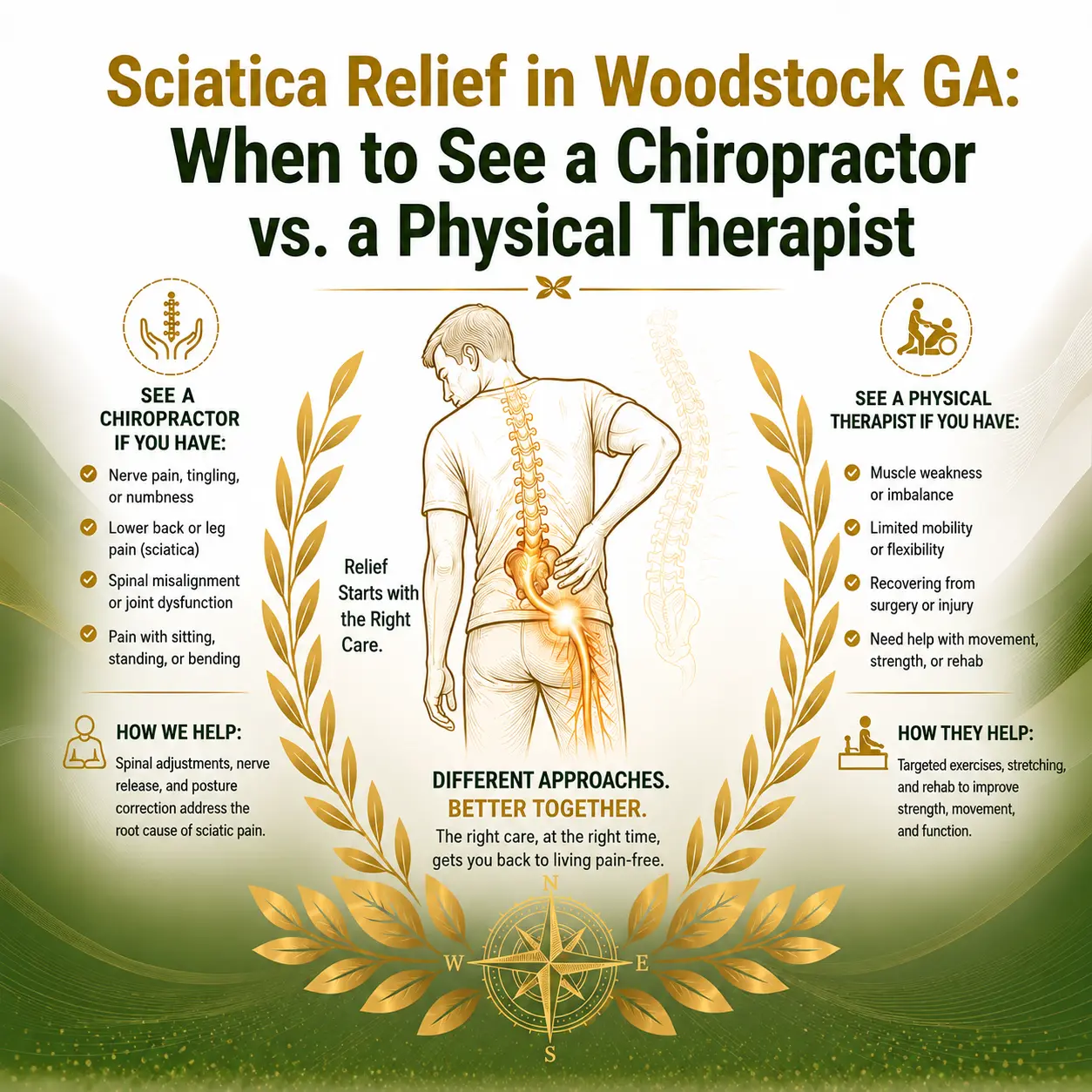
Sciatica Relief in Woodstock GA: When to See a Chiropractor vs. a Physical Therapist
Sciatica can make everyday movement feel impossible, but the right care depends on what is actually causing your pain. In many Woodstock cases, chiropractic care is a strong first option when the problem involves spinal misalignment, nerve irritation, or pressure in the lower back and hips. Physical therapy can also help, especially when the bigger issue is weakness, mobility loss, or rebuilding function after the pain calms down.r
What Sciatica Feels Like
Sciatica is not a diagnosis on its own so much as a pattern of symptoms. It typically causes pain, numbness, tingling, burning, or weakness that starts in the lower back and travels through the hip, buttock, and down one leg. The pain often gets worse when sitting, standing, or walking for long periods, which is why many people start changing how they move before they even realize what is happening.
That pattern matters because sciatica usually points to pressure or irritation on the sciatic nerve rather than a simple sore muscle. Common causes include spinal misalignment, herniated discs, muscle tension, and inflammation in the lower back or hips. Once you understand that, it becomes easier to see why different providers may be helpful at different stages of recovery.
When Chiropractic Makes Sense
Chiropractic care is often the better first step when sciatica is tied to spinal alignment, joint restriction, or nerve pressure. At Ribley Family Chiropractic in Woodstock, sciatica treatment focuses on reducing nerve irritation, calming inflammation, improving spinal mobility, and helping the body heal without medication or surgery. That approach is especially useful when pain starts in the back and clearly radiates down the leg, which suggests the source is mechanical rather than purely muscular.
A chiropractor can evaluate how the spine, pelvis, and surrounding soft tissue are affecting the nerve. Gentle adjustments may help restore proper alignment and reduce the pressure contributing to the flare-up. This can be a smart choice if your symptoms are recent, if they came on after lifting, twisting, a car accident, or a long stretch of sitting, or if you notice pain that changes with spinal position.
Signs Chiropractic May Help First
You may want to start with a chiropractor if your symptoms include:
-
Pain that begins in the low back and travels down one leg.
-
Numbness, tingling, or burning sensations.
-
Pain that worsens with sitting or standing.
-
Tightness in the lower back, hips, or glutes.
-
A history of recurring flare-ups that seem linked to posture or movement.
Chiropractic care is also a strong fit if you want a non-invasive option first. Ribley notes that many sciatica patients begin feeling relief within a few weeks of starting care, though the full timeline depends on how severe the problem is and what caused it in the first place.
When Physical Therapy Helps More
Physical therapy is usually more useful when the acute pain has started to settle, and the main goal is rebuilding strength, mobility, and movement control. A physical therapist often focuses on stretches, strengthening exercises, posture correction, and movement retraining, which can be very helpful once the nerve irritation is less intense. If your back is no longer in constant pain but your leg still feels weak, unstable, or limited, PT may be the better next step.
Physical therapy is also a good fit when your sciatica seems tied to poor mechanics rather than alignment alone. For example, if your pain flares because of weak glutes, a tight hip complex, or repetitive lifting at work, a PT can build a plan around those movement patterns. Some medical providers even recommend PT alongside activity modification as part of the initial conservative approach for persistent sciatica.
Signs PT May Be the Better Fit
Physical therapy may be the right choice if:
-
Your sharp pain has eased, but mobility is still limited.
-
You need help strengthening the core, hips, or glutes.
-
Your symptoms are mostly triggered by repetitive movement or poor posture.
-
You are recovering from a longer-term episode and need functional retraining.
-
You want guided exercises to prevent another flare-up.
PT is often the right next phase after the pain becomes more manageable. It helps you move from symptom relief to long-term stability, which matters if your body has started compensating in ways that could trigger future episodes.
Chiropractor vs. Physical Therapist
Both can help with sciatica, but they usually help in different ways. Chiropractic care tends to be more direct when the issue is nerve pressure from spinal or pelvic misalignment, while physical therapy is often stronger for restoring strength and movement after the pain starts improving. The best choice depends on whether your main problem is pain relief, nerve irritation, or functional recovery.gapain+1
In practice, many people benefit from both at different stages. A chiropractor may help settle the flare-up first, then a physical therapist may help rebuild the strength and movement habits that keep it from coming back. That sequence is especially common when the pain is severe enough that exercise would be hard to tolerate right away.
Why Ribley Family Chiropractic Is a Strong Starting Point
Ribley Family Chiropractic in Woodstock treats sciatica with a non-invasive approach centered on the root cause, not just the symptoms. The practice looks at how spinal misalignment, muscle tension, inflammation, and movement restrictions may be irritating the sciatic nerve, then builds care around those findings. That matters because sciatica usually improves more when the source of pressure is addressed early.
The clinic also emphasizes personalized care, which is important because not every sciatica case is the same. Some people need gentle adjustments, some need soft tissue support, and some need a broader plan that includes restoring flexibility and preventing future flare-ups. A tailored approach helps avoid treating every case like a generic back pain complaint.
When to Get Checked Quickly
Some sciatica symptoms should not be ignored, especially if the pain is becoming worse instead of better. If you have severe weakness, numbness that is spreading, or symptoms that keep intensifying, you should get evaluated promptly rather than trying to wait it out. Long-lasting or recurring sciatica can also signal a deeper issue that needs a more complete care plan.
If your pain started after an accident, lifting injury, or sudden twist, early evaluation is especially important. In those situations, a chiropractor can help determine whether the pain is coming from the spine, hip, or surrounding soft tissue and whether a referral or combined approach would be better. The sooner you identify the cause, the sooner you can stop compensating in ways that make recovery harder.
Choosing the Right Path
The simple rule is this: see a chiropractor first if the pain feels mechanical, radiates from the back, or seems tied to alignment and nerve irritation. See a physical therapist first or next if the pain is easing, but you still need help rebuilding strength, posture, and movement control. If you are unsure, an evaluation with a chiropractor can help you decide whether conservative care alone is enough or whether PT should be added.
For many Woodstock patients, chiropractic care is the fastest way to calm an active sciatica flare-up and get moving again. From there, PT can help maintain the progress and reduce the odds of another episode. That combination gives you both immediate relief and a longer-term plan, which is usually the best outcome for a stubborn condition like sciatica.
Conclusion
Sciatica is frustrating because it affects everything from sitting at work to walking around the house, but you do not have to guess your way through treatment. A chiropractor is often the better first choice when the pain is coming from nerve irritation, spinal misalignment, or pressure in the lower back and hips, while a physical therapist is often the better fit for rebuilding strength and movement once the pain starts to settle. For people in Woodstock looking for a non-invasive approach, Ribley Family Chiropractic offers sciatica care designed to reduce pressure on the nerve and support real recovery.