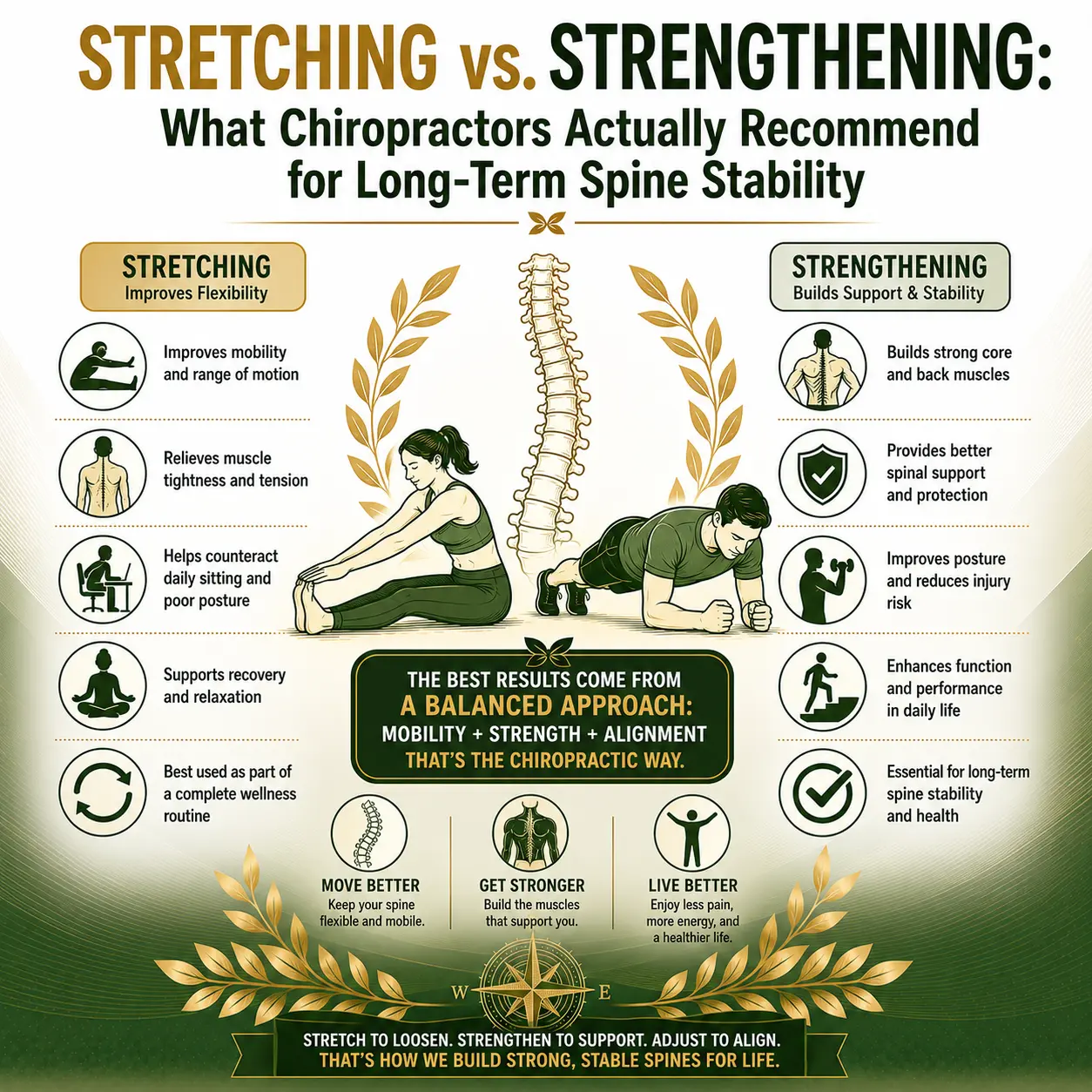
Stretching vs. Strengthening: What Chiropractors Actually Recommend for Long-Term Spine Stability
When your back or neck feels tight, stretching may seem like the obvious answer. You bend forward, pull your knee toward your chest, roll your shoulders, or twist until you feel temporary relief. When discomfort keeps returning, someone may tell you that your core is weak and that you need to start strengthening instead.
Both recommendations can be correct. The problem is that stretching and strengthening address different physical needs. Stretching is generally used to improve mobility and reduce restrictions in muscles and joints. Strengthening helps your body control that mobility, maintain alignment under load, and tolerate the demands of work, exercise, driving, lifting, and daily movement.
For long-term spine stability, chiropractors rarely recommend choosing one and ignoring the other. The better approach is to determine which areas are restricted, which muscles are weak or poorly coordinated, and which movements are repeatedly irritating your spine. Your exercise plan should then combine mobility, strength, endurance, and movement control in proportions that match your condition.
This distinction matters because a tight muscle is not always a short muscle, and a painful back is not always a weak back. Sometimes muscles feel tight because they are working constantly to protect an irritated joint. In other cases, the person has enough flexibility but lacks the strength to control it. Stretching an already unstable area may provide temporary relief without solving the reason the tension developed.
At Ribley Family Chiropractic in Woodstock, active therapies are used to address posture, flexibility, range of motion, and strength alongside chiropractic care. The goal is not simply to help a patient feel looser for an hour. It is to help the body move well enough—and remain strong enough—to handle normal life with less recurring irritation.
The Main Difference Between Mobility and Stability
Mobility describes how freely a joint or body region can move through an appropriate range of motion. Stability describes how well the body controls that movement.
Your spine needs both.
A spine that cannot move adequately may force nearby joints to compensate. For example, limited hip mobility can cause a person to move excessively through the lower back when squatting, getting out of a chair, or lifting something from the floor. Restricted movement in the upper back can also force the neck and shoulders to take on more motion during desk work or overhead activities.
On the other hand, having a large range of motion does not guarantee healthy movement. A person may be flexible enough to touch the floor with straight knees but still experience lower-back pain because the abdominal, hip, and spinal muscles do not control the movement effectively.
Mobility gives you access to motion. Stability lets you use that motion safely.
Long-term spine health depends on having enough movement to complete daily tasks without excessive compensation and enough muscular control to maintain that movement under changing loads.
What Stretching Actually Does
Stretching can improve flexibility, increase tolerance to certain positions, and help reduce the feeling of muscular stiffness. It may be especially useful when a muscle group has become restricted because of prolonged sitting, repetitive work, inactivity, training habits, or a previous injury.
Common targets include the hip flexors, hamstrings, calf muscles, chest muscles, upper trapezius, and muscles surrounding the hips. Improving mobility in these areas may reduce the need for the spine to compensate.
Stretching can also help someone transition from a sedentary position into activity. A person who has spent several hours driving through Metro Atlanta traffic may feel better after gently moving the hips, upper back, and shoulders before beginning a workout or performing yardwork.
However, stretching does not permanently “lengthen” every tight-feeling muscle after a few sessions. Some short-term changes come from the nervous system becoming more comfortable with the stretched position. Maintaining useful improvements generally requires consistent movement, repeated exposure, and enough strength to control the new range.
The World Health Organization includes stretching, strengthening, core training, motor-control exercise, aerobic activity, yoga, Pilates, and mixed exercise programs among the exercise approaches evaluated for chronic primary low-back pain. This supports a broader point: effective spine care usually involves more than one type of movement.
What Strengthening Actually Does
Strengthening improves the ability of muscles to produce, absorb, and control force. For the spine, that does not mean building a rigid midsection or keeping your abdominal muscles braced every minute of the day.
Healthy spinal strength involves coordinated support from several areas, including the abdominal wall, spinal extensors, diaphragm, pelvic floor, hips, glutes, shoulder blades, and legs. These muscles work together to manage pressure, maintain balance, and transfer force between the upper and lower body.
When you pick up a child, carry groceries, climb stairs, push a lawn mower, swing a golf club, or work at a computer, your spine is influenced by forces coming from the rest of your body. Stronger hips and legs can reduce how much work the lower back must perform. Better shoulder-blade control can reduce strain on the neck during reaching and lifting. Improved trunk endurance can help you maintain a comfortable posture for longer periods without excessive fatigue.
Strengthening is particularly important because daily life does not happen in a controlled stretching position. Your body must respond to unexpected loads, uneven surfaces, fatigue, awkward objects, and repeated tasks. Muscular strength and endurance help you manage those demands.
Clinical guidelines for chronic low-back pain support exercise-based care, including motor-control exercises and other forms of physical training. The World Health Organization also recommends structured exercise programs as part of a person-centered approach rather than relying on a single isolated treatment.
Stretching vs. Strengthening: Which Is More Important?
For long-term spine stability, strengthening usually plays the larger role. That does not make stretching unimportant. It means flexibility alone cannot create the muscular endurance and movement control required to support the spine during daily activity.
A useful way to think about it is this: stretching may help you reach a position, while strengthening helps you manage that position.
For example, stretching the hip flexors may make it easier to stand upright after prolonged sitting. Strengthening the glutes and abdominal muscles helps you maintain an upright position while walking, climbing stairs, or lifting. Stretching the chest may make it easier to pull the shoulders back, but strengthening the upper-back and shoulder-blade muscles helps you sustain that position.
A person who only stretches may feel temporary relief but continue experiencing the same tension because the body lacks the capacity to maintain the improved position. A person who only strengthens may add load to a body that cannot yet move through the required range without compensation.
The best answer is usually not stretching or strengthening. It is the right amount of each, performed in the correct order.
Why Constant Stretching Does Not Always Fix Tight Muscles
Many people assume that a muscle feels tight because it needs to be stretched. That is only one possible explanation.
A muscle may also feel tight because it is fatigued, irritated, weak, overworked, or trying to protect an area that feels unstable. Stretching that muscle repeatedly may not address the underlying problem.
Consider someone whose lower back always feels tight after standing. The person may spend several minutes bending forward and pulling the knees toward the chest. That may feel good temporarily. However, the recurring tightness could be related to poor hip endurance, limited ankle mobility, weak glutes, or difficulty controlling the pelvis while standing.
The back muscles may be tightening because they are doing more work than they should. In that situation, the long-term solution may include strengthening the hips and trunk, adjusting standing habits, improving movement mechanics, and gradually increasing activity tolerance.
The same issue can affect the neck. Someone who spends all day at a computer may repeatedly stretch the back of the neck. Yet the discomfort may be driven partly by weak upper-back muscles, poor shoulder-blade endurance, an unsuitable workstation, or hours spent without changing position.
Stretching the painful area is not automatically wrong. It is simply incomplete when the reason for the tension lies elsewhere.
When Chiropractors Commonly Recommend More Stretching
A chiropractor may emphasize mobility work when an examination identifies a meaningful restriction that contributes to poor movement.
Examples may include:
- Limited hip extension that increases lower-back arching while walking or standing
- Restricted upper-back rotation that forces the neck or lower back to twist excessively
- Tight chest muscles that contribute to rounded shoulder positioning
- Reduced ankle mobility that changes squatting, walking, or stair mechanics
- Post-injury stiffness that limits normal daily movement
- Muscular restriction caused by prolonged sitting or repetitive activity
Stretching should be specific. A general routine copied from social media may not address the area creating the problem. In some cases, it can place more stress on the region that is already moving too much.
A person with restricted hips, for instance, may perform a twisting lower-back stretch because that is where tension is felt. The stretch may increase lumbar movement without improving the hip restriction. A better plan would target the hips while teaching the trunk to remain controlled.
When Chiropractors Commonly Recommend More Strengthening
Strengthening may receive more emphasis when the person has adequate range of motion but cannot maintain alignment, resist fatigue, or control movement under load.
This is common among people who sit for long periods, return to exercise after inactivity, recover from an injury, or perform repetitive physical work. It is also common among flexible people who can move through large ranges but experience discomfort because their joints lack sufficient muscular control.
A chiropractor may look for signs such as poor balance, early fatigue, difficulty controlling a squat, hip dropping during single-leg movements, excessive lower-back motion, shoulder-blade instability, or an inability to maintain a comfortable position during simple tasks.
The goal is not to create a perfectly rigid posture. The goal is to improve your ability to move, adjust, and tolerate load without relying on one small area of the spine to do most of the work.
The Muscle Groups That Matter for Spine Stability
Many people associate spine stability only with the abdominal muscles. The abdomen matters, but long-term stability depends on a larger system.
Deep and Superficial Abdominal Muscles
The abdominal wall helps control the rib cage and pelvis while managing pressure around the trunk. Effective abdominal training should involve more than repeated sit-ups. Exercises that resist unwanted extension, rotation, or side bending are often more relevant to daily activities.
Examples may include modified dead bugs, bird dogs, side-plank variations, and controlled carries. The correct exercise depends on the person’s current symptoms and ability.
Glute and Hip Muscles
The gluteal muscles help control the pelvis and generate force during walking, running, climbing, lifting, and standing from a chair. When hip strength is limited, the lower back may compensate.
Bridges, sit-to-stand exercises, step-ups, side steps, and properly coached hip hinges may be used to improve hip strength. Progress should be gradual, especially after an injury or a period of inactivity.
Spinal Extensors
The muscles along the back of the spine help maintain upright posture and control forward bending. These muscles need endurance as well as strength. They should not be ignored simply because the back feels tight.
Appropriate strengthening can help the back muscles tolerate longer periods of standing, lifting, gardening, driving, or working. The key is choosing a level that does not aggravate the condition.
Shoulder-Blade and Upper-Back Muscles
Neck stability is influenced by the upper back and shoulders. Weakness around the shoulder blades can cause the neck muscles to work harder during typing, reaching, carrying, or overhead activity.
Rows, wall slides, controlled pulling movements, and posture-specific endurance exercises may help distribute the workload more effectively.
Legs and Feet
The spine does not function separately from the lower body. Foot position, ankle mobility, leg strength, and balance can all influence how force moves through the knees, hips, pelvis, and lower back.
A complete spine-stability program may therefore include squats, calf raises, step patterns, balance exercises, or walking progressions rather than focusing only on the painful area.
Why Assessment Should Come Before Exercise Selection
Two people with similar symptoms may need different exercises.
One person with lower-back discomfort may have limited hip mobility and need targeted stretching before strengthening. Another may already be highly flexible and need stability training rather than more mobility. A third may have nerve-related symptoms that require a different approach entirely.
A proper assessment may examine posture, walking, balance, joint movement, muscle performance, previous injuries, work demands, exercise history, and the positions that improve or aggravate symptoms. A clinician may also assess reflexes, sensation, strength, or other neurological signs when necessary.
This process helps answer important questions:
- Is the painful area moving too little or too much?
- Is another body region causing compensation?
- Does the person lack strength, endurance, coordination, or mobility?
- Are symptoms affected by sitting, standing, bending, lifting, or rotation?
- Is the exercise appropriate for the patient’s age, health, goals, and current condition?
Ribley Family Chiropractic describes its active therapy as guided, targeted exercise intended to improve posture, flexibility, range of motion, and strength. Its broader care model also emphasizes personalized wellness plans rather than giving every patient the same treatment schedule.
How Chiropractic Care Fits Into the Plan
Chiropractic adjustments may help improve joint motion, reduce pain, and make movement more comfortable for some patients. The National Center for Complementary and Integrative Health identifies spinal manipulation as one of several nondrug approaches used for acute and chronic low-back pain. Research suggests it may produce modest improvements in pain and function, although results vary and it should not be viewed as a universal cure.
That last point is important. Passive care can help create an opportunity for better movement, but exercise helps the patient build the physical capacity needed outside the office.
When a restricted joint moves more comfortably after treatment, mobility exercises can help reinforce that motion. Strengthening can then help the body control the restored range. This is why adjustments, soft-tissue work, stretching, and strengthening may be combined rather than treated as competing approaches.
The purpose is not to make a patient dependent on treatment. A strong plan should help the patient understand what movements are useful, how to perform them safely, and how to maintain progress between visits.
Should You Stretch Before or After Strength Training?
There is no single sequence that applies to every condition, but a common rehabilitation structure is:
- Begin with gentle movement to increase circulation and assess how the body feels.
- Use targeted mobility exercises for areas that are meaningfully restricted.
- Perform activation or motor-control exercises to improve coordination.
- Complete strengthening exercises with controlled technique.
- Finish with light mobility work when it helps reduce post-exercise tension.
Long, aggressive stretching immediately before demanding strength or power exercises may not be appropriate. A warm-up should prepare you for the movements you are about to perform rather than leave the muscles relaxed and poorly prepared to create force.
Dynamic mobility is often more suitable before activity. Longer static stretches may be used afterward or at a separate time, depending on your goals.
Pain should not be used as proof that a stretch or exercise is working. Mild muscular effort or a controlled stretching sensation may be expected. Sharp pain, increasing numbness, spreading tingling, loss of coordination, or worsening weakness should not be ignored.
Common Stretching Mistakes That Can Delay Progress
One common mistake is stretching only the area that hurts. Pain location does not always identify the source of the problem. Hip, shoulder, or ankle restrictions can influence spinal stress.
Another mistake is forcing a deeper range every day. More flexibility is not always better. Mobility should match the demands of your activities and remain under muscular control.
People also tend to hold their breath, bounce into end ranges, or twist aggressively because they want to feel a stronger stretch. These habits can irritate sensitive tissues.
Stretching should not become a substitute for regular physical activity. A ten-minute flexibility routine cannot fully offset eight hours of uninterrupted sitting. Changing position, walking, strengthening, and improving workstation habits may be more important.
Finally, people often stop stretching as soon as they feel better. Useful mobility changes generally need to be maintained through consistent movement and strength training.
Common Strengthening Mistakes That Can Irritate the Spine
The most frequent mistake is progressing too quickly. Adding weight, repetitions, or exercise difficulty before mastering basic control may increase compensation.
Another mistake is copying advanced core exercises that do not match the person’s condition. A difficult plank or high-repetition sit-up routine is not automatically better than a carefully performed beginner exercise.
Holding the breath excessively, moving too fast, and continuing after technique breaks down can also create problems. Strength training should challenge the body, but the challenge should remain controlled.
Some people avoid all spinal movement and try to stay rigid during every activity. Stability does not mean eliminating motion. Your spine is designed to bend, extend, and rotate. The goal is to develop the capacity to perform those movements appropriately rather than fearing them.
How Much Stretching and Strengthening Do You Need?
The correct amount depends on your symptoms, current fitness, daily activities, recovery capacity, and goals. Someone recovering from an auto accident may need a different starting point than a recreational runner, office worker, veteran with an old service-related injury, or older adult trying to remain independent.
Mobility exercises may be performed frequently when they are gentle and well tolerated. Strengthening usually requires recovery time, especially as resistance increases. Some stabilizing or motor-control exercises can be practiced more often because the initial goal is coordination rather than fatigue.
Consistency is more important than completing an exhausting routine once a week. A short program performed several times per week is often more practical than a complicated plan that is abandoned after a few days.
Progress may involve adding repetitions, resistance, time, range of motion, balance demands, or more functional movements. Exercise should become gradually more challenging as the body adapts.
What Long-Term Progress Should Look Like
The success of a spine-stability program should not be judged only by pain intensity. Pain can fluctuate because of stress, sleep, workload, illness, and activity changes.
Better signs of progress include being able to sit or stand longer, lift with more confidence, walk farther, return to exercise, sleep more comfortably, recover faster after activity, or experience fewer flare-ups.
You may also notice that your body no longer feels as tight at the end of each day. This does not always mean you became dramatically more flexible. It may mean your muscles developed enough endurance that they no longer need to guard and compensate as aggressively.
The most useful program is one that improves your ability to live your life—not one that simply produces impressive exercise numbers.
When You Should Not Start a Generic Exercise Routine
Most people benefit from appropriate movement, but some symptoms require medical evaluation before beginning or intensifying a stretching or strengthening plan.
Seek prompt care for back pain accompanied by progressive weakness, significant numbness, fever, unexplained weight loss, trouble walking, severe pain after a fall or accident, or symptoms that continue worsening. Changes in bladder or bowel control, difficulty urinating, or numbness around the inner thighs, buttocks, or genital region require urgent emergency evaluation.
Exercise recommendations should also be modified for pregnancy, osteoporosis, recent surgery, inflammatory conditions, balance problems, cardiovascular disease, and other medical concerns. Your chiropractor or another qualified health professional can help determine whether co-management or referral is appropriate.
What Chiropractors Actually Recommend
A responsible chiropractor does not automatically tell every patient to stretch more or build a stronger core. The recommendation should follow the examination.
In many cases, the plan includes four connected elements:
- Restore necessary mobility in restricted joints and muscles.
- Improve control of the available range of motion.
- Build strength and endurance around the trunk, hips, shoulders, and legs.
- Practice movements that reflect the patient’s daily responsibilities and goals.
For one patient, that may mean improving hip flexibility and learning a proper hip hinge before returning to deadlifts. For another, it may mean strengthening the upper back and changing workstation habits. Someone recovering from an injury may begin with gentle movement and gradually progress toward loaded carries, squats, or sport-specific drills.
The correct balance can also change over time. Early care may focus more on comfortable movement and symptom control. As pain decreases, strengthening and endurance become more important. Later phases should prepare the body for real-life demands rather than stopping as soon as basic exercises become easy.
Building a More Stable Spine in Daily Life
Your exercise routine is only one part of spine health. The positions and movements repeated throughout the day also matter.
Avoid staying in the same position for several hours, even when the posture appears technically correct. The body generally tolerates movement and variation better than prolonged rigidity. Change positions, take brief walking breaks, and adjust your workspace when possible.
When lifting, keep the object close, use your hips and legs, and avoid rushing through awkward movements. When carrying, distribute loads when practical and switch sides rather than relying on one arm every time.
Sleep, stress management, nutrition, and general activity also influence recovery. A tired or stressed body may feel more sensitive and recover more slowly from physical demands. Walking, hydration, consistent sleep, and gradual exercise can support the benefits of targeted chiropractic and active care.
Conclusion
Stretching and strengthening are not competing treatments. They solve different parts of the same movement problem.
Stretching can improve useful mobility and reduce restrictions that force the spine to compensate. Strengthening helps the body control that mobility, tolerate load, maintain balance, and resist fatigue. For long-term spine stability, strengthening often provides the foundation, but it works best when the surrounding joints can move appropriately.
The right plan depends on why your back or neck feels tight, where movement is restricted, which muscles are underperforming, and what activities your body needs to handle. Repeating generic stretches or advanced core workouts without an assessment may provide temporary relief while leaving the main problem unchanged.
Ribley Family Chiropractic serves Woodstock and North Metro Atlanta with chiropractic care, massage therapy, and active therapies designed to improve flexibility, range of motion, posture, and strength. A personalized evaluation can help determine whether your current symptoms require more mobility, more stability, or a carefully sequenced combination of both.
The goal is not simply to become more flexible or stronger. It is to build a spine and movement system that can support your work, family life, exercise, and daily activities with greater confidence and fewer recurring setbacks.