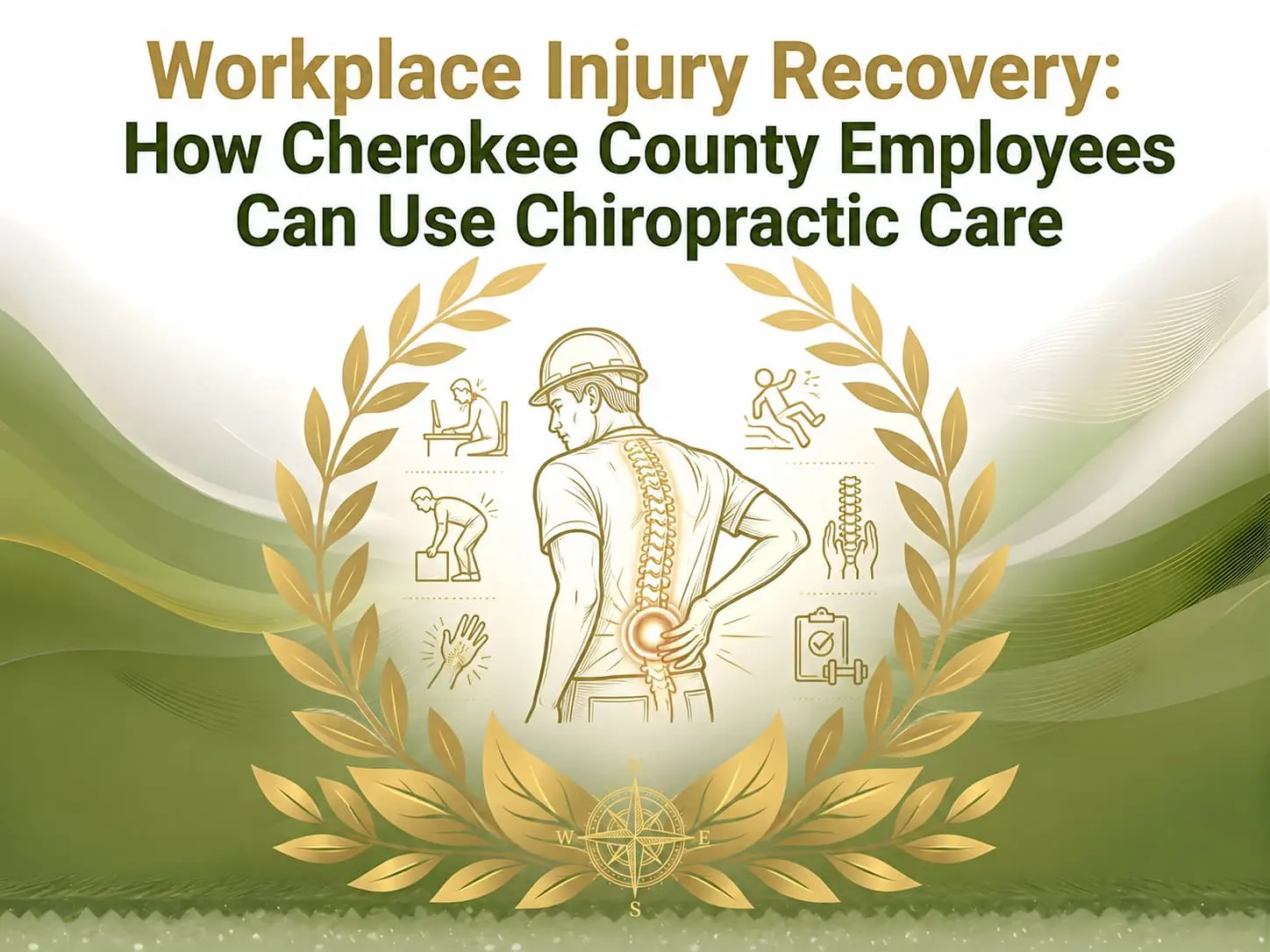
Workplace Injury Recovery: How Cherokee County Employees Can Use Chiropractic Care
A workplace injury can interrupt more than your workday. Back pain may make it difficult to drive home, neck stiffness can interfere with sleep, and a sore shoulder can turn basic tasks such as getting dressed or carrying groceries into uncomfortable challenges. For employees in Woodstock, Canton, Holly Springs, Ball Ground, and other Cherokee County communities, the right recovery plan should address both the injury and the physical demands of the job.
Chiropractic care may be one part of that plan when the injury affects the muscles, joints, spine, or nearby soft tissues. It is not appropriate for every condition, and it should not replace emergency care, diagnostic testing, or treatment from another specialist when those services are needed. The goal is to determine what was injured, rule out serious problems, restore safe movement, and reduce the chance of aggravating the condition when you return to work.
Georgia employees also need to understand how workers’ compensation authorization affects their choice of healthcare provider. Seeing a chiropractor before confirming authorization could create billing or claim problems, even when the treatment itself is reasonable. This guide explains where chiropractic care may fit, what to expect during recovery, and how to protect your health and workers’ compensation rights.
Workplace Injuries Are Not Limited to Heavy Labor
Many people associate workplace injuries with construction sites, warehouses, and physically demanding trades. Employees in those settings do face clear risks from lifting, carrying, pushing, pulling, climbing, tool vibration, overhead work, and awkward body positions. However, office employees, delivery drivers, healthcare workers, retail staff, teachers, technicians, and remote workers can also develop significant musculoskeletal problems.
NIOSH identifies sudden or sustained force, repetitive movement, vibration, and awkward postures as common contributors to work-related musculoskeletal disorders. OSHA also lists heavy lifting, bending, reaching, pushing, pulling, repetitive tasks, and prolonged awkward positioning as recognized workplace risk factors. These conditions may affect the back, neck, shoulders, elbows, wrists, hips, knees, muscles, tendons, ligaments, nerves, and spinal discs.
Some injuries happen during a single event. An employee may slip on a wet floor, twist while carrying a box, get struck by equipment, or feel a sharp pain while helping a patient move. Other problems develop gradually. A desk worker may notice increasing neck pain after weeks of leaning toward a monitor. A delivery driver may develop lower-back stiffness from long periods of sitting combined with repeated lifting. A retail employee may experience shoulder pain after months of stocking shelves overhead.
Gradual symptoms should not be dismissed simply because there was no dramatic accident. Pain, tingling, weakness, reduced grip strength, stiffness, or loss of movement can indicate that repetitive work is placing more stress on the body than it can recover from between shifts.
Where Chiropractic Care May Fit Into Workplace Injury Recovery
Chiropractors primarily evaluate and treat musculoskeletal conditions. These are problems involving muscles, joints, connective tissues, movement, and, in some cases, irritation of nearby nerves. Chiropractic care may be considered for certain work-related back strains, neck strains, joint restrictions, muscle tightness, posture-related discomfort, and mechanical pain that changes with movement.
The evidence should be described accurately. According to the National Center for Complementary and Integrative Health, spinal manipulation is one of several nondrug approaches that may be used for acute or chronic lower-back pain. Research suggests that it may produce small or modest improvements in pain and function. For chronic neck pain, manipulation or mobilization may also reduce pain and improve function, although study quality and results vary. Chiropractic treatment is not guaranteed to eliminate pain, and it should be matched to the patient’s diagnosis, health history, and tolerance.
A workplace injury plan should usually focus on function rather than pain alone. Pain relief matters, but employees also need to regain the ability to sit, stand, bend, lift, carry, reach, walk, drive, use tools, or perform other essential duties without repeatedly aggravating the injured area.
Back Strains and Sprains
Lower-back injuries are common in jobs that involve lifting, twisting, pushing, pulling, driving, or prolonged sitting. A strain affects a muscle or tendon, while a sprain affects a ligament. Symptoms can include localized pain, stiffness, muscle guarding, reduced motion, and pain during bending or changing positions.
Back pain may also come from a disc problem, fracture, nerve irritation, arthritis, infection, or another condition that requires different care. That is why an examination should come before treatment. NIAMS notes that back pain can begin after an accident, fall, or heavy lift, but it can also result from multiple structural, inflammatory, and medical causes.
Neck and Upper-Back Pain
Employees who work at computers, drive for long periods, carry equipment, perform overhead work, or hold their heads in fixed positions may develop pain across the neck, shoulder blades, and upper back. A sudden slip, fall, or impact may also strain the neck.
Depending on the diagnosis, treatment may involve gentle joint mobilization, carefully selected adjustments, soft-tissue techniques, posture changes, and exercises for the neck, shoulders, and upper back. Forceful neck treatment is not appropriate for every patient, particularly when there are neurological symptoms, vascular concerns, fractures, significant trauma, or other contraindications.
Shoulder, Hip, and Extremity Problems
Workplace injuries are not always centered on the spine. Reaching, gripping, climbing, carrying, kneeling, or repeating the same movement can affect the shoulders, elbows, wrists, hips, knees, and ankles. A chiropractor trained in extremity evaluation may assess joint motion, muscle function, movement patterns, and whether pain could be referred from another area.
Some extremity injuries require orthopedic evaluation, diagnostic imaging, immobilization, injections, or surgery. A responsible chiropractor should refer the employee when the examination indicates that another provider is better suited to manage the condition.
Sciatica-Like Symptoms
Pain that travels from the lower back into the buttock or leg is often described as sciatica. It may be accompanied by tingling, numbness, burning, or weakness. These symptoms can result from irritation or compression involving a nerve, but not every case has the same cause.
Spinal manipulation is not a universal treatment for radiating leg pain. NCCIH reports that limited research suggests it may help some people, but the evidence has important limitations. Progressive weakness, loss of sensation, bladder or bowel changes, or severe pain after trauma requires prompt medical assessment rather than routine chiropractic treatment.
What a Work Injury Evaluation Should Include
Treatment should not begin with an automatic adjustment or a standard package of visits. A workplace injury evaluation should begin with a detailed conversation about what happened, what the employee feels, and what the job requires.
The clinician should ask when the symptoms started, whether there was a specific incident, which movements make the pain better or worse, and whether the problem affects sleep or daily activities. The evaluation should also cover previous injuries, surgeries, medical conditions, medications, and any treatment already received.
Job details matter. “Back pain at work” does not provide enough information. The chiropractor may need to know:
- How much weight the employee normally lifts
- How often lifting, bending, reaching, or twisting occurs
- Whether the employee sits, stands, drives, or walks for most of the shift
- Which tools or equipment are used
- Whether vibration, climbing, pushing, or patient handling is involved
- Which duties are currently difficult or impossible
A physical examination may assess posture, walking, balance, range of motion, muscle strength, sensation, reflexes, joint movement, and the way symptoms respond to specific positions. NIAMS identifies medical history and physical examination as central parts of back-pain diagnosis, including tests of movement, reflexes, strength, and sensation.
Imaging Should Be Based on Clinical Need
Not every employee with back or neck pain needs an X-ray, MRI, or CT scan. NIAMS states that most people with back pain do not need additional testing, although imaging may be appropriate when a clinician needs to investigate a fracture, significant trauma, nerve involvement, infection, or another specific condition. X-rays primarily show bones, while MRI is better suited to discs, ligaments, nerve roots, and other soft tissues.
Employees should feel comfortable asking why imaging is being recommended and how the result may change the treatment plan. Imaging findings also need clinical context. Age-related changes may appear on a scan even when they are not the main source of the employee’s current symptoms.
What Chiropractic Treatment May Include
Chiropractic care for a workplace injury should be individualized. Two employees with similar pain locations may need different approaches because their injuries, job duties, health histories, and examination findings differ.
Joint Mobilization or Chiropractic Adjustments
A chiropractor may use controlled manual techniques to improve movement in a stiff or painful joint. Some methods involve a quick, targeted thrust, while others use slower mobilization, specialized tables, handheld instruments, or gentler positioning.
The amount of force should be selected according to the patient’s condition and preferences. A recently injured employee, an older adult, and a healthy athlete should not automatically receive the same technique.
Temporary soreness, stiffness, discomfort, or headache may occur after spinal manipulation. Serious neurological or vascular complications have been reported but are considered very rare, and exact rates are difficult to estimate. A thorough history, appropriate examination, informed consent, and careful technique selection are important, especially before treatment involving the neck.
Active Therapy and Corrective Exercise
Manual treatment may help an employee move more comfortably, but improved movement needs to carry over into daily tasks. Exercises may be used to rebuild strength, flexibility, balance, endurance, and control.
Ribley Family Chiropractic describes its active therapy services as guided, targeted exercises intended to improve posture, flexibility, range of motion, and strength. The clinic may combine stretching, soft-tissue work, trigger-point techniques, and movement-based care with chiropractic treatment.
For a warehouse employee, active therapy may focus on hip mobility, abdominal control, and safe lifting mechanics. An office employee may need upper-back endurance, neck control, and workstation changes. A healthcare worker may need training in bracing, foot position, and using transfer equipment. Exercises should relate to the demands the employee will face upon returning to work.
Soft-Tissue Treatment
Muscles may tighten around an injured area as the body tries to protect it. Depending on the diagnosis, a treatment plan may include massage, myofascial techniques, or trigger-point work to address muscle tension and improve comfortable movement.
Soft-tissue treatment should support active recovery rather than become the entire plan. An employee may feel better after massage, but long-term progress often depends on restoring strength, adjusting work demands, and avoiding the movement pattern that caused or aggravated the problem.
Workers’ compensation authorization should be confirmed separately for massage or other additional services. Approval for a chiropractic examination does not automatically mean that every recommended service will be covered.
Home and Workplace Recommendations
Recovery continues between appointments. A chiropractor may recommend temporary changes to sitting, sleeping, lifting, driving, or other daily activities. The employee may also receive a short home program involving walking, mobility work, gentle strengthening, or position changes.
These recommendations should be specific. Advice such as “use better posture” is difficult to apply. A useful recommendation may explain where to place a monitor, how often to change position, how to approach a lift, or which movement should be limited until strength improves.
Georgia Workers’ Compensation Rules to Understand Before Scheduling
Employees should address workers’ compensation requirements early. The healthcare provider who gives good clinical care may still be considered unauthorized by the insurance carrier if the proper provider-selection process was not followed.
Report the Injury Immediately
Georgia’s Bill of Rights for injured workers states that an accident should be reported immediately and no later than 30 days after it occurs. Failure to report within that period may result in the loss of benefits. Reporting promptly also creates a clearer record of when, where, and how the injury happened.
Tell a supervisor, manager, foreman, or designated employer representative as soon as possible. Follow the employer’s written reporting procedure and keep a personal copy of any incident report, email, text message, or form you submit.
For gradually developing pain, report the symptoms once you believe work is causing or worsening them. These claims can involve more questions about timing and causation, so accurate documentation is important.
Ask for the Panel of Physicians or WC/MCO Information
Georgia employers generally meet their medical-care obligation by posting a traditional panel of physicians or information for a certified workers’ compensation managed care organization. Under the traditional panel system, an employee may choose a physician from the list and make one change to another physician on the same panel without prior permission. A WC/MCO has its own network and process for helping the employee select a provider.
The Board’s current rules also address situations in which a claim is disputed or an employer fails to provide the required physician-selection process. Those exceptions can be fact-specific. Employees should contact the Georgia State Board of Workers’ Compensation or speak with a workers’ compensation attorney rather than assuming an outside provider will automatically be authorized.
Confirm Chiropractic Authorization
A chiropractor may be listed on the employer’s panel, included in the WC/MCO network, selected through an approved referral, or authorized through an agreement involving the employer and insurance carrier. The correct route depends on the claim.
Before scheduling, ask the adjuster or employer:
- Is chiropractic care authorized for this injury?
- Must I choose from a specific provider list?
- Do I need a referral from the authorized treating physician?
- Has the requested clinic received written authorization?
- Which services and number of visits have been approved?
Georgia’s Bill of Rights states that authorized medical bills and certain related expenses are paid when the injury was caused by an on-the-job accident. The key word is authorized.
Emergency Care Is Different
In an emergency, Georgia’s Bill of Rights allows an injured employee to obtain temporary medical care from any doctor until the emergency is over. After that, treatment generally returns to the provider-selection requirements of the workers’ compensation system.
An employee with a suspected fracture, major head injury, severe bleeding, chest pain, breathing difficulty, loss of consciousness, or rapidly worsening neurological symptoms should seek emergency help instead of delaying care while trying to arrange a chiropractic appointment.
When to Seek Urgent Medical Care Instead
Chiropractic care is not the first step for every workplace injury. Seek urgent or emergency medical evaluation when there are signs of a fracture, spinal cord injury, significant nerve damage, brain injury, infection, or another serious condition.
Warning signs include:
- Loss of consciousness or difficulty waking after a head impact
- A worsening headache, repeated vomiting, seizure, slurred speech, or increasing confusion
- One pupil becoming larger than the other
- New weakness, numbness, loss of coordination, or difficulty walking
- Trouble urinating or loss of bladder or bowel control
- Severe back or neck pain following a fall or forceful impact
- Fever combined with significant back pain
- Unexplained weight loss with persistent pain
- An obvious deformity, open wound, or suspected broken bone
The CDC advises immediate emergency care for worsening headache, repeated vomiting, weakness, numbness, seizures, slurred speech, unusual behavior, unequal pupils, increasing confusion, or loss of consciousness following a possible concussion. NIAMS also recommends medical evaluation for back pain associated with trauma, urination problems, leg weakness or numbness, fever, or unexplained weight loss.
Recovery Should Include More Than Passive Treatment
An adjustment, massage, or heat application may provide temporary relief, but workplace injury recovery should prepare the employee for real movement and real job demands. A plan that only reduces symptoms while the employee is lying on a treatment table may not be enough.
NIAMS recommends avoiding prolonged bed rest for most back pain, limiting activities that clearly increase symptoms, and gradually increasing physical activity as tolerated. Strengthening and movement training can improve mobility, posture, and positioning.
That does not mean an injured employee should push through sharp pain or test heavy lifting before receiving clearance. It means recovery should progress from protected movement to controlled exercise and then to job-specific activity.
A practical progression might involve walking without a pain increase, restoring comfortable range of motion, performing basic strengthening, practicing safe movement patterns, and gradually increasing tolerance for sitting, standing, lifting, or carrying.
Returning to Work Without Reinjuring the Area
Returning to work is not the same as being completely free of every symptom. Some employees can safely work with temporary modifications while healing continues. The key is making sure the duties match the employee’s current abilities.
Possible restrictions may include limits on lifting, carrying, pushing, pulling, overhead reaching, repetitive bending, climbing, driving, or prolonged sitting. Other employees may need shorter shifts, more frequent position changes, assistance with patient handling, or access to a cart or lifting device.
Georgia’s workers’ compensation rules give the authorized treating physician an important role in approving suitable employment. When a formal offer of modified work is made under the applicable process, the job duties and written medical approval matter. Employees should not ignore a valid return-to-work notice, but they should promptly report when assigned duties conflict with restrictions or produce a significant increase in symptoms.
Use Functional Goals
Treatment goals should connect directly to the job. “Reduce pain” is too broad by itself. Better goals include sitting for 45 minutes without escalating symptoms, lifting a 20-pound object with controlled mechanics, turning the head far enough to drive safely, or completing a shift with scheduled position changes.
Functional goals help the employee, chiropractor, authorized treating physician, employer, and adjuster understand whether recovery is moving forward.
Correct the Workplace Risk
Treatment cannot fully compensate for an unchanged hazard. An employee who improves but returns to the same poorly positioned workstation, unsafe lifting process, or repetitive overhead task may experience another flare-up.
NIOSH recommends designing work to fit employees’ capabilities and using appropriate tools, equipment, and ergonomic controls. OSHA emphasizes employee involvement, early symptom reporting, hazard identification, and workplace changes that reduce exposure to musculoskeletal risks.
Recovery Examples for Different Cherokee County Employees
Office and Remote Employees
Computer work can lead to prolonged sitting, forward head positioning, rounded shoulders, and limited movement throughout the day. Treatment may address neck and upper-back mobility, but the workstation also needs attention.
The monitor should be positioned so the employee does not repeatedly lean forward or rotate the neck. Frequently used items should be easy to reach. The employee should be able to change positions rather than trying to maintain one “perfect” posture for the entire day.
Short movement breaks, upper-back exercises, and a properly supported sitting position may be more helpful than simply replacing one office chair with another.
Warehouse, Delivery, and Trade Workers
These jobs often combine lifting, carrying, driving, pushing, pulling, climbing, and time pressure. Recovery may require rebuilding leg and trunk strength while improving the way loads are approached.
Employees should avoid twisting while holding a heavy object. When possible, the feet should be repositioned so the whole body turns together. Loads should be kept close, and carts, dollies, team lifts, or mechanical assistance should be used when available.
The correct lifting method depends on the object, the workspace, and the employee’s restrictions. A generic instruction to “lift with your legs” does not solve a task that requires reaching into a deep bin or moving an irregular object.
Healthcare and Childcare Employees
Patient transfers and child handling can involve unpredictable movement, awkward positions, and loads that shift without warning. Treatment should be paired with training in transfer equipment, assistance procedures, foot placement, and communication with coworkers.
An employee recovering from a back or shoulder injury should not silently resume a two-person transfer alone because the unit is busy. Work restrictions need to be communicated and followed.
Retail and Hospitality Employees
Retail and hospitality jobs may require long periods of standing, shelf stocking, cleaning, carrying trays, moving supplies, and working in confined areas. Recovery may involve gradual standing tolerance, supportive footwear, alternating tasks, changing shelf height, or reducing repetitive overhead reaching.
Pain that develops late in a shift can be useful information. It may indicate that the employee has enough strength for short tasks but not yet enough endurance for the full workload.
How to Measure Progress
Pain scores provide only one piece of information. Workplace injury recovery should also be measured by changes in movement and daily function.
Useful progress markers include:
- Improved range of motion
- Reduced numbness or radiating pain
- Better strength, balance, or grip
- Increased sitting, standing, walking, or driving tolerance
- Improved ability to sleep and complete daily tasks
- Fewer symptom flare-ups after work activity
- Increased ability to perform approved job duties
- Reduced dependence on frequent passive treatment
Progress should be reassessed regularly. When an employee is not improving as expected, the clinician should reconsider the diagnosis, treatment approach, work exposure, need for imaging, or need for referral. Continuing the same care indefinitely without measurable improvement is not a sound recovery strategy.
How Long Does Workplace Injury Recovery Take?
There is no universal treatment schedule for workplace injuries. A mild muscle strain may improve within days or weeks, while a disc injury, fracture, significant nerve problem, or condition requiring surgery may take much longer.
NIAMS classifies acute back pain as pain lasting from a few days to a few weeks, subacute pain as lasting approximately four to 12 weeks, and chronic pain as lasting longer than 12 weeks. These categories describe duration, not the number of chiropractic visits a person should receive.
The treatment plan should be based on the diagnosis, severity, job demands, response to care, and functional progress. Employees should understand what the clinician expects to improve, when progress will be measured, and what will happen if the expected improvement does not occur.
How to Choose a Chiropractor for a Workplace Injury
Choose a licensed chiropractor who performs a thorough examination, explains the working diagnosis, discusses risks and alternatives, and is willing to coordinate with other healthcare providers.
Ask whether the office has experience with workplace injuries and workers’ compensation documentation. Confirm that the clinic understands the difference between ordinary health insurance coverage and workers’ compensation authorization. A provider should also be willing to refer you when symptoms fall outside the appropriate scope of chiropractic care.
Be cautious about promises of immediate cures, predetermined long-term treatment packages, or claims that every workplace symptom comes from the same spinal problem. A credible plan should be specific to your injury and should include measurable goals.
Using Ribley Family Chiropractic for a Work-Related Injury
Ribley Family Chiropractic has served Woodstock and North Metro Atlanta since 1995. The Towne Lake clinic offers chiropractic care, active therapy, and massage services, with treatment plans based on the patient’s concerns and examination. Its active therapy program includes guided exercises intended to improve posture, flexibility, range of motion, and strength.
The clinic is located at 2453 Towne Lake Parkway in Woodstock and can be reached at 770-592-2505. Ribley states that it accepts insurance plans that include chiropractic benefits, but workers’ compensation claims involve a separate authorization process. Employees should contact both the clinic and the workers’ compensation adjuster before beginning care to verify provider approval, referrals, covered services, and billing requirements.
Bring the incident date, employer information, adjuster contact details, claim number, provider authorization, relevant medical records, and a description of your normal job duties. Clear information at the beginning can reduce delays and help the chiropractor understand what recovery needs to accomplish.
Frequently Asked Questions About Chiropractic Care After a Workplace Injury
Can I Go to Any Chiropractor After a Work Injury in Georgia?
Not necessarily. Your employer may use a posted panel of physicians or a certified WC/MCO. You may have a choice within that approved system, and Georgia rules permit certain provider changes and exceptions, but you should confirm authorization before treatment.
Will Workers’ Compensation Pay for Chiropractic Care?
Workers’ compensation may pay for authorized treatment related to a covered workplace injury. Payment is not guaranteed simply because the employee believes chiropractic care would help. The provider and services generally need to follow the claim’s authorization process.
Can Chiropractic Care Help a Work-Related Back Strain?
It may help some employees with mechanical lower-back pain, particularly when manual care is combined with gradual activity, exercise, and changes to the task that caused the problem. Research suggests spinal manipulation may provide modest improvements for some people, but results vary.
Should I Wait to See Whether the Pain Goes Away?
Do not delay reporting the injury. Georgia requires prompt notice and warns that waiting beyond 30 days may jeopardize benefits. After reporting, follow the employer’s medical-care process and seek urgent care immediately when serious symptoms are present.
Do I Need an X-Ray Before Chiropractic Treatment?
Not everyone does. Imaging should be based on the history, examination, trauma involved, and suspected diagnosis. Most people with uncomplicated back pain do not need additional testing, but imaging may be appropriate when a fracture, nerve problem, or other specific condition is suspected.
Can I Continue Working While Receiving Chiropractic Care?
Possibly. Some employees can remain at work with temporary restrictions or modified duties. Formal restrictions and return-to-work decisions should be coordinated with the authorized treating physician and workers’ compensation process. Do not perform duties that clearly conflict with written restrictions.
Conclusion
Chiropractic care can play a useful role in workplace injury recovery for some Cherokee County employees, especially when the problem involves mechanical back pain, neck stiffness, restricted joint movement, muscle tension, or reduced function. The strongest plans combine appropriate hands-on care with exercise, activity progression, ergonomic changes, and clear return-to-work goals.
The first priority is safety. Serious trauma, head-injury danger signs, progressive weakness, bladder or bowel changes, suspected fractures, and other red flags require immediate medical care. The second priority is proper authorization. Report the injury promptly, request the employer’s physician panel or WC/MCO information, and confirm that chiropractic treatment is approved before scheduling.
For employees considering Ribley Family Chiropractic in Woodstock, contact the clinic and your workers’ compensation representative with the claim information before beginning treatment. A coordinated plan can help reduce administrative delays while keeping the focus where it belongs: restoring safe movement, rebuilding job capacity, and returning to work without repeating the same injury.