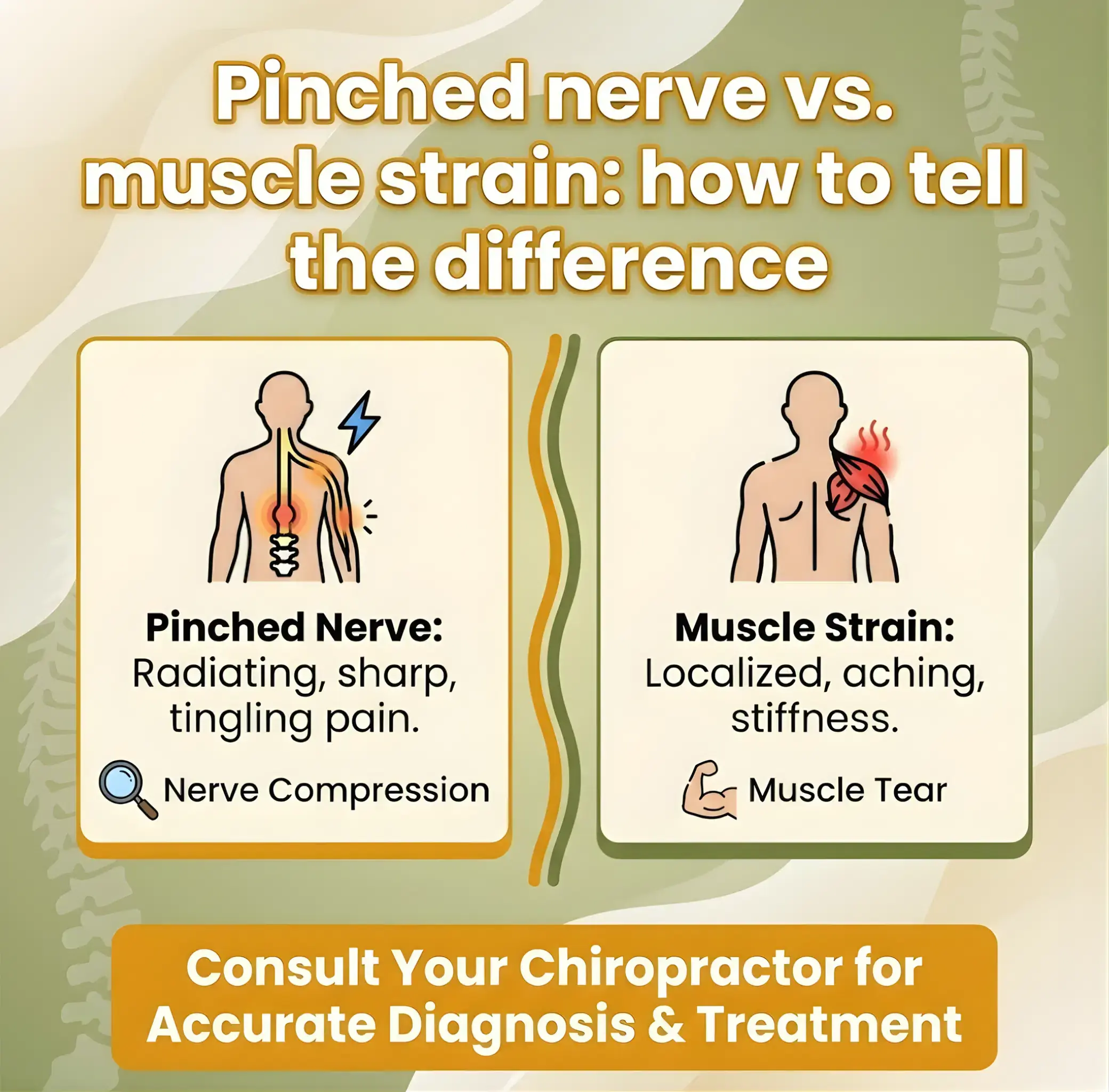
Pinched Nerve vs. Muscle Strain: How to Tell the Difference
If you suddenly feel pain in your neck, back, shoulder, arm, or leg, it can be hard to know whether it is a pinched nerve or a muscle strain. Both can hurt enough to limit movement and disrupt daily life, but they come from different problems and often need different approaches. A pinched nerve involves pressure on a nerve from nearby bone, disc, or soft tissue, while a muscle strain is damage to the muscle or tendon fibers themselves. Understanding the key differences in how the pain feels, where it travels, and what other symptoms you notice can help you decide when to try home care and when to see a healthcare provider.
What a Pinched Nerve Feels Like
A pinched nerve happens when surrounding structures—like a herniated disc, bone spur, swollen muscle, or tight ligament—press on a nerve root or peripheral nerve. That pressure irritates the nerve, which then sends abnormal signals along its pathway. This is why pinched‑nerve pain often does not stay in one small spot; it tends to radiate.
Common signs of a pinched nerve include sharp, shooting, or burning pain that travels along the nerve’s path, such as from the lower back down the leg (sciatica) or from the neck into the shoulder, arm, or hand. Tingling, “pins and needles,” or numbness in the area the nerve supplies, which may come and go or feel constant, is another hallmark. Muscle weakness or difficulty using the affected limb, such as trouble gripping objects, lifting the foot, or walking normally, can also point to nerve involvement.
Pinched‑nerve symptoms can develop gradually from long‑term poor posture, repetitive motions, or spinal changes, or they can flare suddenly after a specific movement. The pain may worsen with certain positions—like bending forward, sitting for long periods, or turning the head—and may persist even when you are resting. Because the nerve is irritated rather than just sore, symptoms can linger for days to weeks if the underlying pressure is not addressed.
What a Muscle Strain Feels Like
A muscle strain, sometimes called a pulled muscle, occurs when muscle or tendon fibers are overstretched or torn. This often happens during sudden exertion, heavy lifting, awkward twisting, or overuse. Unlike a pinched nerve, the problem is in the muscle itself, not in a compressed nerve.
Typical signs of a muscle strain include localized pain that stays in or very near the injured muscle, such as a sore spot in the lower back, shoulder, hamstring, or calf. The pain is usually a dull, aching, or tight sensation that may feel worse when you contract or stretch the muscle. Stiffness, tenderness, and sometimes visible swelling or bruising over the affected area are also common.
Muscle‑strain pain usually improves with rest, gentle movement, ice or heat, and over‑the‑counter anti‑inflammatories, especially in mild to moderate cases. True muscle weakness is less common; you may feel sore and limited, but you can usually still use the muscle unless the strain is severe. In contrast to a pinched nerve, a simple strain rarely causes tingling, numbness, or electric‑like sensations beyond the immediate sore area.
Key Differences in Symptoms
Although both conditions can cause significant discomfort, several features help distinguish a pinched nerve from a muscle strain.
Pinched‑nerve pain often radiates along the nerve’s path, for example from the spine into the arm or leg, while muscle‑strain pain usually stays localized to the injured muscle. Tingling, numbness, or “pins and needles” strongly suggest nerve involvement and are uncommon with a simple muscle strain. Noticeable loss of strength in a muscle group is more typical of a pinched nerve than of a muscle strain. Swelling, bruising, and a very tender spot over the muscle are more characteristic of a strain, whereas a pinched nerve often lacks obvious local swelling.
If you feel burning or electric‑like pain that travels, plus tingling or weakness, a pinched nerve is more likely. If the pain is a deep ache confined to one area and feels worse when you move or press on the muscle, a strain is more likely. These patterns are not absolute, but they give a useful starting point for deciding how to manage your symptoms.
How Each Condition Usually Starts
The way the pain begins can also offer clues.
Pinched‑nerve symptoms may appear gradually over days or weeks, often linked to posture, repetitive motions, or existing spinal issues such as disc problems or arthritis. In some cases, a sudden movement or awkward position can trigger a flare‑up of an already irritated nerve. Muscle strain, on the other hand, is more likely to follow a specific event: lifting something heavy, a sudden twist, a fall, or intense exercise. You may recall the exact moment the pain started and feel a “pull” or “pop” in the muscle at that time.
If you cannot pinpoint a clear injury and the pain feels more like burning, tingling, or traveling discomfort, nerve involvement is more plausible. If you clearly overdid it with a lift, twist, or workout and the pain is localized and sore, a strain is more likely. This timeline can help you decide whether to focus on rest and gentle movement or to seek a more thorough evaluation.
How They Respond to Home Care
Both conditions can benefit from rest, ice, and gentle movement, but their responses often differ.
Pain from a mild or moderate muscle strain usually improves over a few days to a couple of weeks with rest, ice in the first 48 hours, and gentle stretching or light activity once acute soreness decreases. Over‑the‑counter anti‑inflammatories and heat after the first few days can also help ease stiffness and soreness. If you avoid re‑injuring the muscle and gradually return to activity, many strains resolve without further intervention.
Home care can ease discomfort from a pinched nerve, but symptoms such as radiating pain, tingling, or weakness may persist or fluctuate without targeted treatment. If the nerve remains compressed, symptoms can linger or even worsen over time, especially if aggravating postures or activities continue. If pain and tingling do not improve after a week or two of conservative care, or if weakness or numbness increases, it is important to seek professional evaluation.
When to See a Healthcare Provider
Some red flags suggest you should not try to “wait it out” at home.
Seek prompt medical or chiropractic care if you notice new or worsening numbness, tingling, or weakness in an arm or leg. Difficulty walking, lifting objects, or controlling bladder or bowel function can signal serious nerve compression and requires urgent attention. Severe, unrelenting pain that does not respond to rest, ice, or over‑the‑counter medication is another reason to get checked.
A clinician can perform a physical exam, assess your strength and sensation, and, if needed, order imaging to determine whether the problem is primarily nerve‑related, muscular, or both. Early, accurate diagnosis helps you avoid unnecessary strain on an already irritated nerve or muscle and guides the right mix of manual therapy, exercise, and lifestyle changes.
How Treatment Usually Differs
Treatment for a pinched nerve and a muscle strain can overlap but often emphasizes different priorities.
For a pinched nerve, the focus is on reducing pressure on the nerve and calming irritation. This may include posture correction, nerve‑glide exercises, manual therapy (such as chiropractic adjustments or physical therapy), and, in some cases, medications or injections. Long‑term management often involves strengthening core and stabilizing muscles and improving ergonomics to prevent recurrence.
For a muscle strain, treatment centers on healing the injured tissue and restoring flexibility and strength. Relative rest, ice and heat, gentle stretching, and progressive strengthening exercises are common. Gradual return to activity helps prevent stiffness and re‑injury. In some cases, a severe muscle strain can cause enough swelling to press on a nearby nerve, creating a mix of muscle and nerve symptoms. A clinician can untangle these overlapping patterns and tailor treatment accordingly.
Simple Ways to Protect Yourself at Home
Whether your pain turns out to be nerve‑ or muscle‑related, certain habits reduce the chance of making it worse.
Avoid prolonged sitting or standing in one position; change posture frequently and take short walks. Use proper lifting technique: bend at the knees, keep the object close to your body, and avoid twisting while lifting. Maintain a supportive sleep position and mattress that keep your spine in a neutral curve. Warm up before exercise and stretch afterward to keep muscles supple and joints mobile.
These habits do not guarantee you will never strain a muscle or irritate a nerve, but they make both outcomes less likely and less severe when they do occur.
Conclusion
Pinched nerves and muscle strains can both cause significant pain, but they differ in how the pain feels, where it travels, and what other symptoms appear. A pinched nerve often brings sharp, burning, or radiating pain with tingling, numbness, or weakness, while a muscle strain usually causes localized, dull, aching pain with stiffness and tenderness in the muscle. Recognizing these patterns helps you choose more appropriate home care and know when it is time to see a professional. If symptoms are severe, worsening, or include new weakness or numbness, prompt evaluation is important to protect nerve function and get the right treatment.