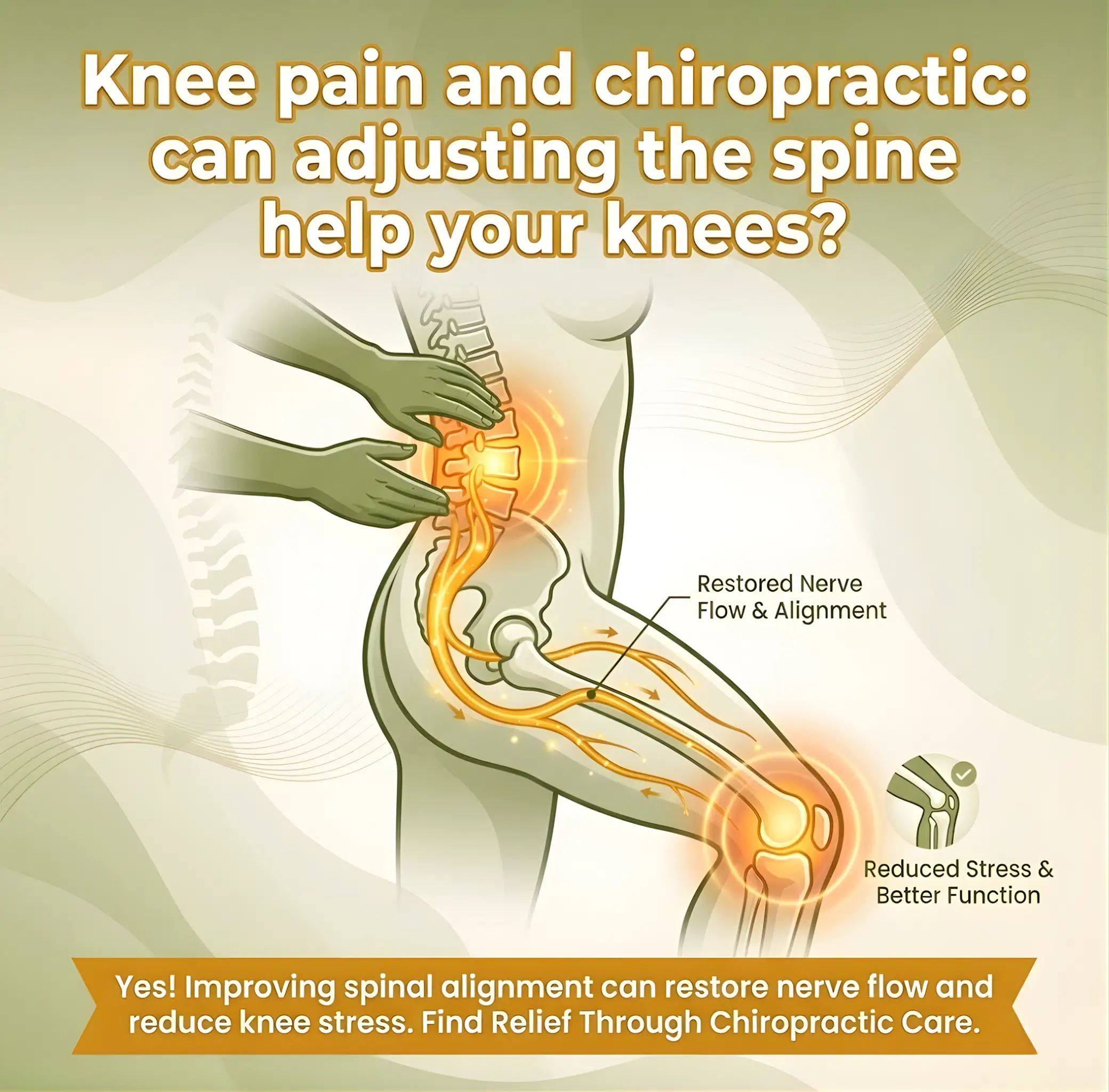
Knee Pain and Chiropractic: Can Adjusting the Spine Help Your Knees?
If you have been told your knee pain is “just wear and tear” or that your only options are medication, injections, or surgery, you may not have heard the full story. Chiropractic care is often thought of as a treatment for back and neck pain, but it can also play a meaningful role in knee‑pain management—sometimes by adjusting the spine. The reason is simple: your knees do not work in isolation. They are part of a chain that runs from your feet, through your ankles and hips, up your pelvis and lower back, and all the way to your spine. When alignment or nerve function higher up is off, your knees often pay the price.
This article explains how spinal and pelvic adjustments can influence knee pain, what types of knee problems are most likely to respond, and what else chiropractors typically add to the picture—posture correction, extremity adjustments, and exercise—so you can decide whether this approach might be right for you.
How your spine and pelvis affect your knees
Your spine and pelvis act as the central “control tower” for how your whole body moves and carries weight. When the lumbar spine or pelvis is misaligned, rotated, or stiff, the way your legs track through space changes. That altered pattern can shift more load onto one side of the knee, increase shear forces across the joint, or change how the kneecap tracks over the femur.
Nerves that exit the lower back also supply muscles around the hip, thigh, and knee. If those nerves are irritated or compressed by a misaligned vertebra or tight soft tissue, the muscles they control can become weak, tight, or uncoordinated. That imbalance pulls unevenly on the knee, which can mimic or worsen conditions like patellofemoral pain, IT‑band syndrome, or early osteoarthritis. In this sense, knee pain can be a downstream symptom of a problem that started higher up.
When spinal adjustments can help knee pain
Spinal adjustments are not a magic cure for every kind of knee problem, but they can be particularly useful in certain situations.
If your knee pain is linked to low‑back or pelvic misalignment that changes your gait or posture, nerve‑related symptoms such as dull ache, burning, or tingling that travel from the back into the thigh or knee, or muscle imbalances or weakness in the hip and thigh that pull abnormally on the knee, then addressing the spine and pelvis can reduce the abnormal forces acting on the knee joint. Gentle, controlled adjustments aim to restore normal motion to restricted spinal segments, reduce nerve irritation, and improve how weight is distributed through the lower body. When the spine and pelvis move more freely and symmetrically, the knees often experience less strain and more balanced loading, which can ease pain and improve function.
How chiropractors assess knee‑related problems
A chiropractor who treats knee pain will usually start with a broader view than just the joint itself. The assessment often includes observing your posture, gait, and how you stand and walk, looking for pelvic tilt, leg‑length differences, or foot pronation that might be contributing to knee stress. The practitioner will also test the range of motion and alignment of your spine, pelvis, hips, ankles, and knees to see where restrictions or asymmetries exist.
Muscle strength, tone, and trigger points in the lower back, glutes, hamstrings, quadriceps, and calves are checked because tight or weak muscles can pull the knee out of its ideal position. This whole‑body approach helps identify whether your knee pain is primarily local, such as a meniscus tear or advanced arthritis, or whether it is being driven or worsened by biomechanical issues higher up. In many cases, it is a combination of both.
What happens during a chiropractic visit for knee pain
A typical chiropractic visit for knee pain may include several components, not just spinal adjustments.
Spinal and pelvic adjustments use gentle, targeted thrusts or mobilizations to restore motion to restricted joints in the lower back and pelvis, which can improve nerve flow and reduce compensatory strain on the knees. Many chiropractors also adjust the knee itself, as well as the ankle and hip, to improve joint mechanics and reduce stiffness or tracking problems. Soft‑tissue work such as myofascial release, trigger‑point therapy, or instrument‑assisted soft‑tissue mobilization can loosen tight muscles and fascia that are pulling on the knee.
Chiropractors often prescribe specific stretches and strengthening exercises for the hips, core, and lower legs to support better alignment and reduce future flare‑ups. The goal is not just to reduce pain in the moment but to change how your body moves so the knee is less likely to be overloaded again.
Types of knee pain that may respond to chiropractic care
Chiropractic care is not a substitute for urgent orthopedic or surgical care, but it can be helpful for several common, non‑emergency knee issues.
Patellofemoral pain, often called runner’s knee, involves pain around or behind the kneecap and frequently relates to hip and pelvic mechanics, foot posture, and muscle imbalances. Addressing spinal and pelvic alignment, along with hip and knee‑specific exercises, can reduce pressure on the patella. IT‑band syndrome, which causes pain on the outer side of the knee, is often tied to weak glutes, tight hip flexors, and altered gait patterns that can be influenced by spinal and pelvic alignment.
Early or mild osteoarthritis can also benefit from chiropractic care. While this approach cannot reverse cartilage loss, improving joint mechanics, reducing inflammation, and strengthening supporting muscles can ease pain and improve function. Some people experience knee‑like discomfort that actually stems from irritated nerves in the lumbar spine; in these cases, spinal adjustments can reduce the nerve irritation and the perceived knee pain.
For more severe structural problems—such as large meniscus tears, ligament ruptures, or advanced joint destruction—chiropractic care is usually part of a broader plan that may include orthopedic evaluation, imaging, and, in some cases, surgery.
How spinal alignment changes the way you walk and stand
Your gait and posture are subtle but powerful drivers of knee health. When the spine and pelvis are out of alignment, your body compensates by shifting weight unevenly, rotating your hips, or changing how your feet strike the ground. Over thousands of steps a day, those small changes add up to extra stress on one side of the knee or abnormal tracking of the kneecap.
By restoring better spinal and pelvic alignment, chiropractic care can help even out how weight is distributed between your legs, reduce rotational forces that twist the knee joint, and improve the timing and coordination of muscles that stabilize the knee during walking and running. When your body moves more efficiently, the knee does not have to work as hard to keep you upright and mobile, which can lead to less pain and more endurance.
What the research and clinical experience suggest
Evidence on chiropractic care for knee pain is still evolving, but several themes emerge from both clinical practice and emerging studies. Improved spinal alignment and posture are associated with better gait mechanics and reduced stress on the knee joints. Patients with knee pain related to low‑back or pelvic dysfunction often report less discomfort and better function after a course of spinal and extremity adjustments, soft‑tissue work, and exercise.
Chiropractic care is increasingly viewed as a non‑invasive, conservative option that can delay or reduce the need for medications, injections, or surgery in some people. None of this means chiropractic works for everyone or replaces medical evaluation when needed. It does mean that, for many people, addressing the spine and pelvis as part of a broader knee‑pain strategy can make a real difference.
When to see a doctor versus a chiropractor
Knee pain can have many causes, and some are urgent. You should seek prompt medical or orthopedic evaluation if you notice sudden, severe swelling, redness, or warmth around the knee, especially with fever; inability to bear weight, significant instability, or a feeling that the knee is “giving way”; or a clear history of trauma such as a fall or twist with immediate swelling or deformity.
In these situations, imaging and possibly surgical consultation are important, and chiropractic care is usually secondary or supportive. For chronic, activity‑related knee pain without red‑flag signs, a chiropractor can be a reasonable first or complementary option, especially if you also have low‑back or hip discomfort or notice that your posture or gait feels off.
Simple ways to support your knees at home
Whether or not you pursue chiropractic care, a few habits can reduce strain on your knees and make any treatment more effective. Wear supportive, well‑fitting shoes and consider orthotics if you have flat feet or overpronation. Maintain a healthy weight to reduce compressive forces on the knee joints. Strengthen your hips and core with exercises that improve stability without overloading the knees. Avoid prolonged sitting with your knees bent at a sharp angle, and take frequent breaks to stand and move.
These steps do not replace professional care, but they create a better environment for your knees to heal and function.
Conclusion
Knee pain does not always mean the problem is inside the knee joint. Misalignments or nerve irritation in the spine and pelvis can alter how you stand, walk, and move, which in turn places extra stress on the knees. Chiropractic care can help by adjusting the spine and pelvis, improving posture and gait, and adding targeted work to the knee, hip, and ankle. For many people, this whole‑body approach reduces pain, improves function, and decreases the risk of future flare‑ups. If your knee pain is chronic, activity‑related, or accompanied by low‑back or hip symptoms, seeing a chiropractor as part of a broader care plan is a reasonable step to explore.