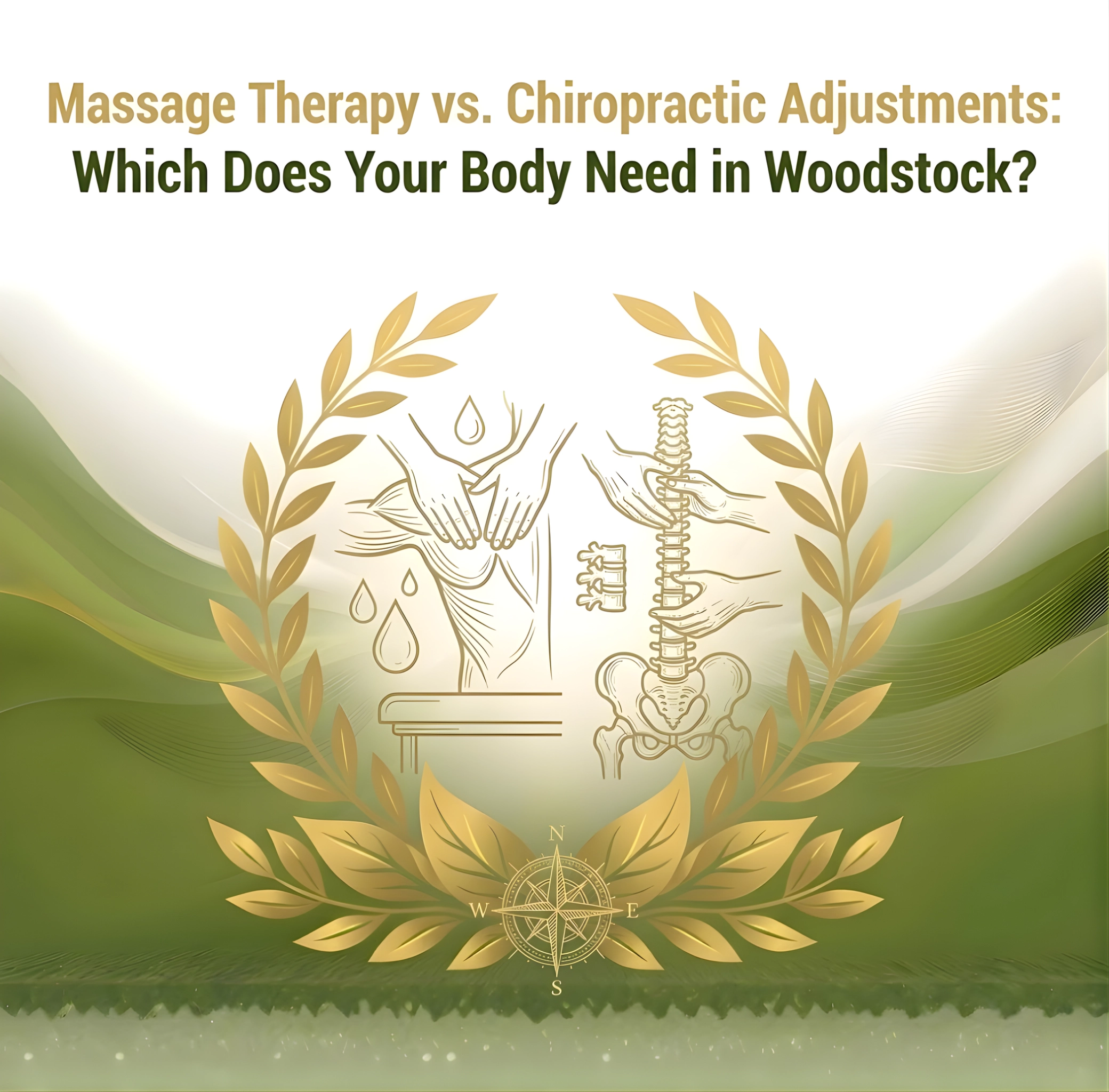
Massage Therapy vs. Chiropractic Adjustments: Which Does Your Body Need in Woodstock?
Massage Therapy vs. Chiropractic Adjustments: Which Does Your Body Need in Woodstock?
If your body has been sending warning signs lately, you may be wondering whether massage therapy or chiropractic adjustments are the better choice. The short answer is this: massage therapy is often the better fit for muscle tension, stress, and soreness, while chiropractic care is often the better fit for joint restriction, spinal discomfort, posture problems, and recurring movement issues.
The challenge is that many people in Woodstock do not feel only one thing. They may have tight shoulders, a stiff neck, low back pain, headaches, or hip tension all at once. That is why the better question is not always “Which one is better?” but “Which one does my body need right now?”
Why this choice matters
A lot of people wait too long to get help because they assume pain will settle down on its own. Sometimes it does. Often, it does not. What starts as mild stiffness after a long workweek can turn into ongoing pain that affects sleep, workouts, driving, desk work, and even simple daily movement.
That is where the difference between massage therapy and chiropractic adjustments becomes important. Both can be helpful, but they work in different ways and target different problems. Choosing the right option can save you time, frustration, and money, especially if you want relief that lasts longer than a day or two.
For many people in Woodstock, the right care also depends on how they use their bodies. A parent lifting kids all week may need something different than a golfer, warehouse worker, office employee, runner, or someone recovering from a fender bender. Your job, routine, posture, stress load, and injury history all shape which treatment will feel best and work best.
What massage therapy does
Massage therapy mainly works with soft tissue. That includes muscles, fascia, and the general tension patterns that build up from stress, repetition, overuse, poor posture, or physical activity. When people say they feel tight, knotted, sore, overworked, or tense, they are often describing something massage therapy is designed to address.
In practical terms, massage therapy can help when your body feels like it is constantly bracing. Maybe your shoulders stay raised all day. Maybe your upper back feels heavy by the afternoon. Maybe your calves are tight after running, or your neck feels locked after staring at a screen. In these cases, the muscles themselves may be one of the biggest reasons you feel uncomfortable.
Massage is also often a more intuitive entry point for people new to hands-on care. It feels familiar. Most people understand the idea of releasing tension, improving comfort, and helping the body calm down. If your pain seems closely tied to stress, overtraining, long hours at a desk, or general muscle fatigue, massage may be a smart place to start.
That said, massage therapy is not only for relaxation. It can also be part of a focused care plan for people with repetitive strain, sports soreness, tension headaches, restricted mobility due to tight tissue, and recovery needs after physical exertion. The key is knowing whether the main driver of your discomfort is muscular, structural, or a mix of both.
What chiropractic adjustments do
Chiropractic adjustments focus more on joint motion, spinal mechanics, alignment issues, and the body’s movement as a system. When a joint is not moving well, the surrounding muscles often tighten up to protect the area. That means some people who think they only have “tight muscles” are actually dealing with an underlying movement problem.
Chiropractic care is commonly used for back pain, neck pain, joint restrictions, posture-related discomfort, and recurring mechanical issues that return even after stretching or rest. Sports-focused chiropractic care often combines adjustments with soft tissue work and rehabilitation exercises rather than relying on one method alone.
This matters because stiffness is not always just stiffness. If your neck keeps locking up, your low back repeatedly flares up after sitting, or one hip always feels off during workouts, your body may need more than muscle relief. It may require a change in how the joints move and how force is distributed throughout the body.
A good chiropractor does not simply chase the painful spot. Chiropractic injury care often centers on evaluating the problem, identifying contributing movement issues, and creating an individualized plan based on function rather than symptoms alone. That is often what makes the care feel more targeted for people with recurring pain instead of one-time tension.
Massage therapy may be the better choice if…
If your discomfort feels broad, heavy, and muscular, massage therapy may be the right first step. This is especially true when your symptoms are linked to stress, long workdays, overtraining, travel, or postural fatigue rather than a clear joint problem.
Massage may be the better fit when:
- Your shoulders, neck, or back feel tight rather than unstable
- Your soreness started after stress, overuse, or a hard workout
- You want to reduce muscle tension and improve comfort quickly
- You feel better with pressure, heat, and hands-on tissue work
This option often makes sense for people whose bodies feel overworked but not structurally “stuck.” If you can move fairly well, but everything feels guarded, tender, or fatigued, massage may help your body relax enough to recover.
Massage is also a strong choice when your nervous system feels overloaded. Some people carry stress physically before they even realize how tense they are. They clench their jaw, hold their breath, elevate their shoulders, and tighten their low back without noticing. In that situation, massage can be useful not only for the tissue itself but also for interrupting the pattern of constant tension.
Chiropractic adjustments may be the better choice if…
If your issue feels sharp, recurring, movement-related, or centered around the spine or joints, chiropractic care may be the better starting point. This tends to be the case when a problem keeps returning, affects the range of motion, or seems connected to posture, mechanics, or nerve irritation.
Chiropractic care may be the better fit when:
- Your neck or back keeps “going out.”
- One side feels restricted, uneven, or harder to move
- Pain increases with certain motions, positions, or lifting
- Stretching helps only for a short time, then the problem returns
This is often where people in Woodstock say, “I get temporary relief, but it never really fixes the issue.” That phrase matters. Temporary relief is useful, but if the same problem repeats every week, the body is telling you there is more going on than simple muscle tightness.
Chiropractic care may also be a better choice if your symptoms affect function. For example, if turning your head while driving is difficult, if standing up from a chair triggers low back pain, or if your posture collapses by midday, no matter how often you stretch, a structural and movement-focused assessment can be more useful than tissue work alone.
When both are the right answer
A lot of people do not neatly fit into one category. They have tight muscles because their joints are not moving well. Or they have joint pain because the surrounding muscles are constantly overworking. In real life, the body is rarely that simple.
That is why massage therapy and chiropractic adjustments often work well together. Massage can reduce tissue tension, calm guarding, and make the body more receptive to change. Chiropractic care can then address how the joints move and how the body carries load during daily activity. In some cases, chiropractic clinics also include soft tissue treatment, rehab exercises, and movement guidance as part of the same plan.
This combined approach can be especially useful for people dealing with chronic desk posture, old sports injuries, recurring low back pain, tension headaches, shoulder tightness, or recovery after physically demanding work. If your symptoms have been present for a while, the best answer may not be choosing one forever. It may be choosing the right starting point and adjusting the plan as your body responds.
How to tell what your body is asking for
One of the easiest ways to decide between massage therapy and chiropractic adjustments is to pay attention to the quality of the discomfort, not just the location. Two people can both say “my back hurts,” while needing completely different care.
If your pain feels like soreness, tension, fatigue, pressure, or muscle tightness that spreads across an area, massage therapy may be more helpful. If your pain feels like a pinch, recurring catch, sharp restriction, limited range of motion, or pain that keeps returning in the same pattern, chiropractic care may be the stronger option.
It also helps to ask a few simple questions:
Does the problem feel muscular or mechanical?
Muscular issues often feel broad and achy. Mechanical issues often feel specific and repeatable. If bending, twisting, or turning triggers the exact same pain every time, that points more toward a movement problem than to general tissue fatigue.
Is the relief lasting or temporary?
If you already get massages and feel great for a day or two, but then the same problem returns, your body may need more than muscle work. That does not mean the massage failed. It may mean the muscle tension is a response to something deeper, such as posture strain, joint restriction, or repetitive movement stress.
Has the problem become part of your routine?
When pain starts shaping your behavior, it is time to look more closely. Maybe you avoid turning your head fully. Maybe you brace every time you lift laundry or groceries. Maybe you sit differently because one side of your back always feels off. These patterns suggest that your body is adapting to a problem that should be properly evaluated.
Common Woodstock situations and what may help
In a local setting like Woodstock, people often deal with the same clusters of complaints. Long commutes, desk jobs, active weekends, parenting demands, gym training, yard work, and physically demanding jobs all create predictable stress patterns in the body.
If you work at a computer most of the day and end every week with upper back tension and a stiff neck, massage therapy may be a great first step. It can help unwind the tissue strain that builds from static posture and stress.
If you have low back pain that flares up whenever you sit for too long, stand up, or lift something awkwardly, chiropractic care may be more appropriate. The reason is not just pain relief. It is necessary to examine how your spine, hips, and supporting muscles work together.
If you are active on weekends and always feel sore after pickleball, golf, weight training, or long runs, the right answer may depend on whether the issue feels like routine muscle fatigue or a recurring injury pattern. Recurring sports-related chiropractic care often includes hands-on treatment plus rehab-based guidance to improve movement and reduce repeat strain.
If stress is clearly the main factor and your body feels globally tense rather than injured, massage therapy may be the more natural first choice. If you feel uneven, restricted, or mechanically stuck, chiropractic care may help you more directly.
What to expect from massage therapy
A well-delivered massage session should feel focused, not random. Your therapist should ask which areas bother you, what types of pressure feel productive, and whether your goal is recovery, tension relief, mobility improvement, or general relaxation.
Some sessions are full-body and aimed at lowering overall tension. Others are more clinical and focused on a specific area, such as the neck, low back, hips, or shoulders. If your symptoms are mostly muscular, you may notice that massage helps you move more freely, sleep better, and feel less guarded in your body.
What massage usually does best is create space. It reduces the feeling that everything is clenched, compressed, or overworked. For many people, that alone is enough to change how they function throughout the week.
Still, massage has limits. If the issue is driven by joint dysfunction, recurring spinal mechanics, or a persistent movement imbalance, you may feel relief without full correction. That does not make massage the wrong choice. It simply means the root cause may need another layer of care.
What to expect from chiropractic care
A strong chiropractic visit should start with questions, not assumptions. Your provider should want to know how the problem began, what aggravates it, what makes it better, how long it has been present, and whether the issue is affecting work, exercise, or sleep.
For many musculoskeletal complaints, chiropractic care is not just about the adjustment itself. Chiropractic clinics treating injury and movement problems often develop care plans that include assessment, joint-based treatment, soft-tissue support, exercise guidance, and practical advice for daily life.
That broader approach is one reason some people do better with chiropractic care after trying only stretching or massage. If the real issue is how the body moves under load, a plan that addresses mechanics, tissue tension, and stability often makes more sense than temporary symptom relief alone.
A good chiropractor should also be clear about what care can and cannot do. If your issue seems outside the scope of conservative treatment, you should be told that directly. Trust matters just as much as technique.
The biggest mistake people make
The most common mistake is choosing care based only on what feels good in the moment. Relief matters, but the better question is whether the care is changing the pattern that keeps bringing the pain back.
It is easy to choose the option that seems more familiar or less intimidating. Many people book a massage because it sounds simpler. Others prefer chiropractic care because they want a more structural approach right away. Neither instinct is wrong. The problem comes when people continue using the same option even when the results are clearly incomplete.
If your body keeps asking for the same help every week, listen to that pattern. The goal is not endless maintenance for a problem that never improves. The goal is progress.
How to decide in Woodstock
If you are trying to choose between massage therapy and chiropractic adjustments in Woodstock, start by being honest about how your body feels and how long the issue has been going on. Do not reduce it to “I hurt.” Get more specific.
Ask yourself whether the problem feels like tension, fatigue, and soreness, or like restriction, instability, and recurring pain. Think about whether your symptoms are stress-driven, activity-driven, or position-driven. Notice whether the discomfort moves around or shows up in the same exact pattern every time.
If you are still unsure, choose the provider who seems most committed to assessment rather than routine. The best care usually starts with someone who listens carefully, evaluates how you move, and explains why a certain approach fits your symptoms. That is a much better sign than someone pushing a canned treatment plan before understanding your body.
When not to guess
Some symptoms should not be treated as simple muscle tension or minor stiffness. Severe pain, major trauma, numbness, significant weakness, worsening symptoms, or pain that feels alarming deserves prompt medical attention.
This is where trust and professional judgment matter. Good providers do not force every problem into the same box. They recognize when conservative care makes sense and when a patient needs a more thorough evaluation.
If your symptoms are mild to moderate and seem related to posture, movement, soft-tissue tension, or everyday strain, massage therapy or chiropractic care may be reasonable options. If your symptoms are intense, sudden, or unusual, get evaluated appropriately first.
Conclusion
Massage therapy and chiropractic adjustments are not competing answers to the same problem. There are different tools for different kinds of stress, pain, and movement issues. If your body feels tight, overworked, and tense, massage therapy may be the better fit. If your body feels restricted, uneven, or stuck in a recurring pain pattern, chiropractic care may be the best place to start.
For many people in Woodstock, the real answer is not choosing one side forever. It is choosing the right care for the problem in front of you. When treatment matches the reason your body hurts, recovery tends to feel faster, more practical, and far less frustrating.