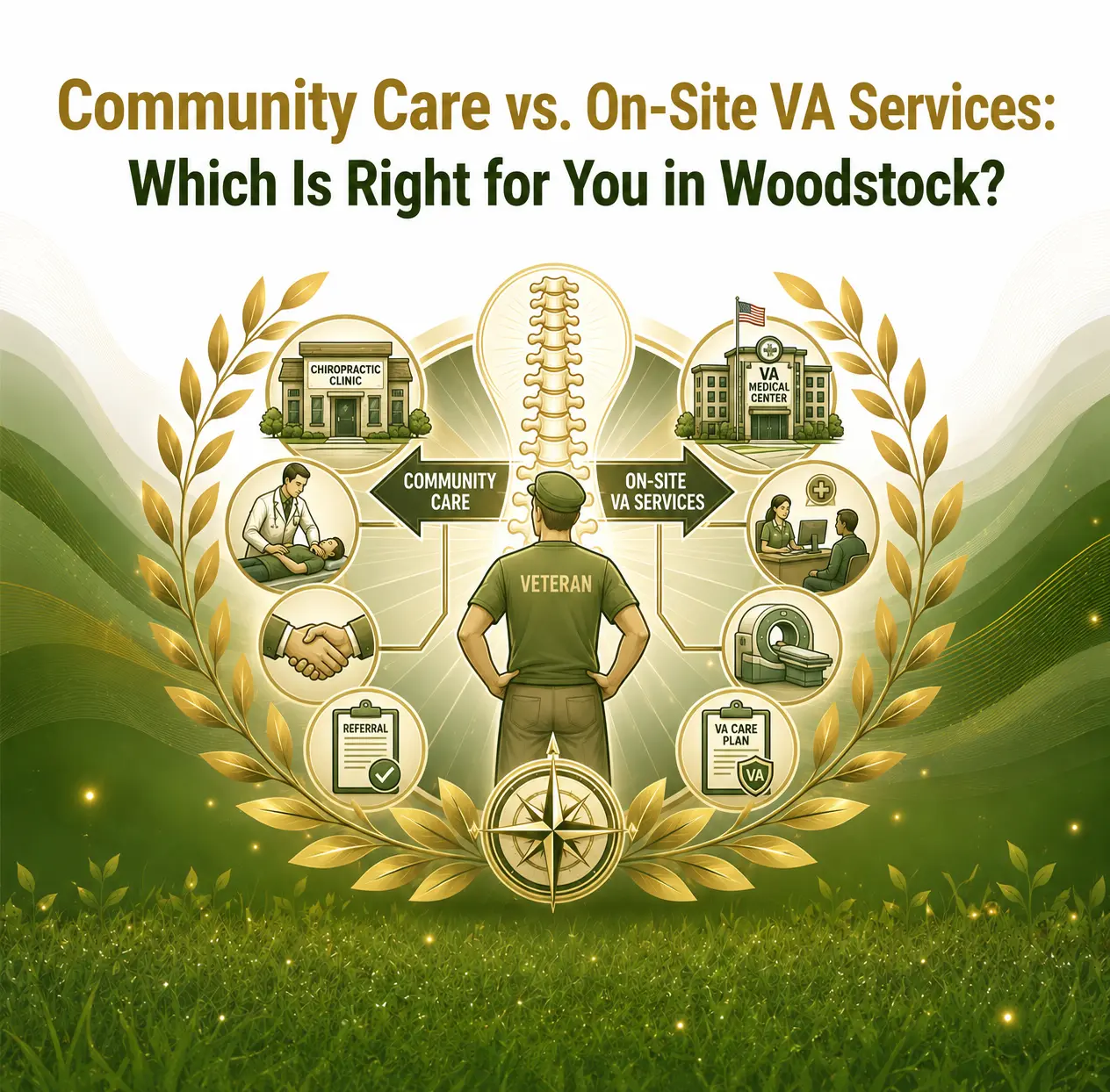
Community Care vs. On-Site VA Services: Which Is Right for You in Woodstock?
Community Care vs. On-Site VA Services: Which Is Right for You in Woodstock?
If you’re a veteran living in or around Woodstock, you’ve probably run into this question at some point: Should you use VA Community Care to see a local provider or stick with on-site VA services? It’s not always an obvious choice, and the answer depends on more than just convenience. At Ribley Family Chiropractic, we work with veterans regularly, and we want to help you understand your options clearly so you can make the decision that actually fits your life and your health needs.
This isn’t about steering you in one direction. It’s about giving you honest, practical information so you walk away knowing exactly what each path looks like — including how chiropractic care fits into the picture.
What Is the VA Community Care Program?
The VA Community Care Network (CCN) is a program that allows eligible veterans to receive healthcare from approved providers outside of the VA system. It was significantly expanded under the VA MISSION Act of 2018, which gave veterans more access to community-based care when certain conditions are met — like long wait times at VA facilities, distance from a VA location, or when the VA simply doesn’t offer a specific type of service the veteran needs.
In practical terms, this means a veteran in Woodstock may qualify to see a local chiropractor, physical therapist, or specialist without having to drive to a VA medical center. The VA pays for the care directly through the Community Care Network, so there’s typically little to no out-of-pocket cost for eligible veterans. That’s a significant benefit for people who either can’t travel long distances or who need a type of specialized care — like chiropractic — that is available in their community but may not be easily accessible at every VA facility.
Community Care doesn’t mean you’re leaving the VA system. Your care is still coordinated through the VA, and your treatment records get shared back to your VA provider. Think of it as an extension of VA care rather than a replacement.
What Are On-Site VA Services?
On-site VA services refer to care delivered directly at a VA medical center or VA outpatient clinic. The Hines VA Medical Center in the Chicago area, for example, serves a large veteran population across northern Illinois, and there are outpatient clinics scattered across the region that provide primary care, mental health services, specialty referrals, and more.
For veterans who live close to a VA facility and have straightforward healthcare needs, on-site services can be excellent. The VA has made major strides in improving care quality, and for certain treatments — particularly those involving complex trauma, prosthetics, or veteran-specific mental health programs — on-site VA resources are often the most comprehensive option available.
However, the VA system is not without its challenges. Wait times can stretch out, appointment availability varies by location, and not every VA facility offers every type of service. Chiropractic care, for instance, is something many veterans need for service-related back and neck injuries, but access to it through the VA directly can be limited depending on where you live. That gap is exactly where Community Care steps in.
Key Differences Between the Two Options
Understanding the structural differences between these two paths helps you make a smarter choice for your specific situation.
Access and Convenience
Community Care lets you see a local, VA-approved provider in Woodstock rather than driving to a VA facility. For veterans dealing with mobility limitations, chronic pain, or busy work and family schedules, this flexibility is more than a convenience — it’s a real factor in whether care actually happens consistently. On-site VA services, while sometimes requiring more travel, give you access to a broader range of specialists under one roof.
Wait Times
One of the qualifying criteria for Community Care is excessive wait times at VA facilities. If your VA clinic can’t get you in within 20 days for primary care or 28 days for specialty care, you may automatically qualify to use a community provider instead. This is a meaningful distinction for veterans in pain who can’t afford to wait weeks before being seen.
Provider Relationship
Seeing a local provider through Community Care often means more personalized, consistent care. At a practice like Ribley Family Chiropractic, you’re not a number in a large institutional system. Your provider knows your history, your treatment goals, and how your body responds over time. That kind of continuity matters when you’re managing a chronic condition or recovering from an injury.
Coordination of Care
On-site VA services have a built-in coordination advantage — your primary care doctor, specialists, and mental health team are all connected within the same system. Community Care providers are required to send notes back to the VA, but the integration isn’t always seamless. It’s worth keeping your VA primary care provider in the loop when you’re receiving community care so nothing falls through the cracks.
Who Qualifies for VA Community Care in Woodstock?
Not every veteran automatically qualifies for Community Care. The VA uses a set of eligibility criteria that includes the following situations:
- The VA cannot provide the care you need (e.g., a specific specialty or service like chiropractic isn’t available locally through the VA)
- The nearest VA facility providing the required service is more than 30 minutes away for primary care, or more than 60 minutes away for specialty care
- The VA cannot schedule an appointment within the access standards mentioned above
- You live in a state or U.S. territory without a full-service VA medical center
- The VA determines that community care is in your best medical interest
If you’re unsure whether you qualify, the best starting point is to contact your VA primary care team or call the VA Community Care line directly. You can also ask providers like Ribley Family Chiropractic — we’re familiar with the process and can help point you toward the right steps.
Chiropractic Care Through VA Community Care
Why Veterans Seek Chiropractic Treatment
Back pain, neck pain, and musculoskeletal injuries are among the most common service-related conditions affecting veterans. Years of carrying heavy gear, physical training, deployment-related injuries, and the general wear of military service leave a lasting impact on the spine and joints. Many veterans manage this with medication alone, but chiropractic care offers a non-pharmaceutical, hands-on approach that addresses the root cause rather than just masking symptoms.
Research supports chiropractic care for veterans specifically. Studies have shown that spinal manipulation is effective for low back pain — one of the most frequently reported conditions in the veteran population — and that chiropractic treatment can reduce reliance on opioid medications. Given the VA’s push toward whole-health, integrative approaches to veteran care, chiropractic fits naturally into that framework.
How Ribley Family Chiropractic Works with VA Community Care
At Ribley Family Chiropractic in Woodstock, we have experience working with veterans through the VA Community Care program. The process typically starts with your VA provider issuing a referral or authorization for community care. Once that’s in place, you can schedule directly with our office.
From your first visit, we focus on understanding not just your current pain, but your full health history — including any service-related injuries, prior treatments, and long-term goals. Veterans often come in dealing with layered issues: a lower back injury that’s been compensated for years, resulting in hip and knee problems down the line. That’s the kind of full-picture thinking we bring to your care.
We communicate back to your VA provider as required, so your care team stays informed and your records remain complete. Our goal isn’t to replace your VA care — it’s to fill a gap, extend your access, and give you quality chiropractic treatment right here in your community without the burden of long drives or wait times.
On-Site VA Chiropractic: What to Expect
Many VA medical centers do have chiropractic departments, and if you’re close to one and can get timely access, it can be a solid option. VA chiropractors are licensed and trained professionals, and they operate within a care team model that allows for easy collaboration with your other VA providers.
The challenge, as mentioned, is access. Not every VA outpatient clinic in the region offers chiropractic, and even those that do may have limited appointment availability. Veterans dealing with acute pain often can’t wait three to six weeks for an appointment. When the VA’s own access standards aren’t being met, Community Care is specifically designed to bridge that gap.
If you’ve already tried accessing chiropractic through the VA and hit a wall — either because it’s not available at your local clinic or the wait times are excessive — that’s a clear signal that Community Care may be the right path for you.
Making the Decision: Practical Questions to Ask Yourself
The right choice between Community Care and on-site VA services comes down to your individual situation. Here are some honest questions worth thinking through:
- How far are you from your nearest VA facility that offers chiropractic or the care you need?
- Have you already tried to get an appointment through the VA and been told there’s a long wait?
- Is your condition time-sensitive, or can you afford to wait for on-site availability?
- Do you prefer a smaller, community-based practice where you see the same provider consistently?
- Are there specific treatments or approaches — like chiropractic — that aren’t readily available at your VA location?
There’s no single right answer. Some veterans benefit most from the comprehensive, integrated care the VA offers on-site. Others are better served by the flexibility and personalized attention that comes with a local community provider. Many veterans use both — on-site VA for primary and mental health care, and Community Care for chiropractic or physical therapy.
How to Get Started with VA Community Care in Woodstock
If you think Community Care might be a good fit, the process is more straightforward than many veterans expect.
First, talk to your VA primary care provider and explain what you need. If you’re looking for chiropractic care and it’s not available locally through the VA, ask them to initiate a Community Care referral. You can also self-schedule in some cases if you already meet the eligibility criteria — the VA has been working to make the process less bureaucratic.
Second, make sure the community provider you choose is part of the VA Community Care Network. Ribley Family Chiropractic is set up to accept VA Community Care patients, so once your authorization comes through, reaching out to us is simple. We’ll handle the administrative side on our end and make sure your first appointment is focused entirely on your health, not paperwork.
Third, keep your VA care team in the loop throughout your treatment. Even though Community Care providers send notes back to the VA, being proactive about communication helps ensure continuity and avoids any gaps or miscommunications in your care.
Why Local Care Matters for Veterans
There’s something genuinely important about receiving care in your own community. Veterans shouldn’t have to choose between quality care and living their daily lives. Traveling long distances for appointments, navigating large institutional settings, and dealing with fragmented care experiences all add stress to people who are already managing health challenges.
Woodstock has a real veteran community, and practitioners like Ribley Family Chiropractic are part of that community. We’re not just a provider you see once — we’re a consistent presence in your healthcare picture. When you see the same chiropractor regularly, they understand your body, your history, and your progress in a way that a rotating roster of providers simply can’t replicate. That relationship is part of the care, and it matters.
The VA Community Care program exists precisely because policymakers recognized that veterans deserve access to quality care close to home. Using it isn’t a workaround — it’s the program working exactly as intended.
Conclusion
Choosing between VA Community Care and on-site VA services isn’t a one-size-fits-all decision, and it doesn’t have to be permanent. What matters most is that you’re getting consistent, effective care for the conditions affecting your quality of life.
If you’re a veteran in Woodstock dealing with back pain, neck pain, or any musculoskeletal issue and you’re curious about whether chiropractic care through VA Community Care is an option for you, reach out to Ribley Family Chiropractic. We’re here to answer your questions, help you understand the process, and provide the kind of hands-on, patient-centered care that you’ve earned. Your service matters, and so does your health — and you shouldn’t have to navigate a confusing system alone to get the care you need.