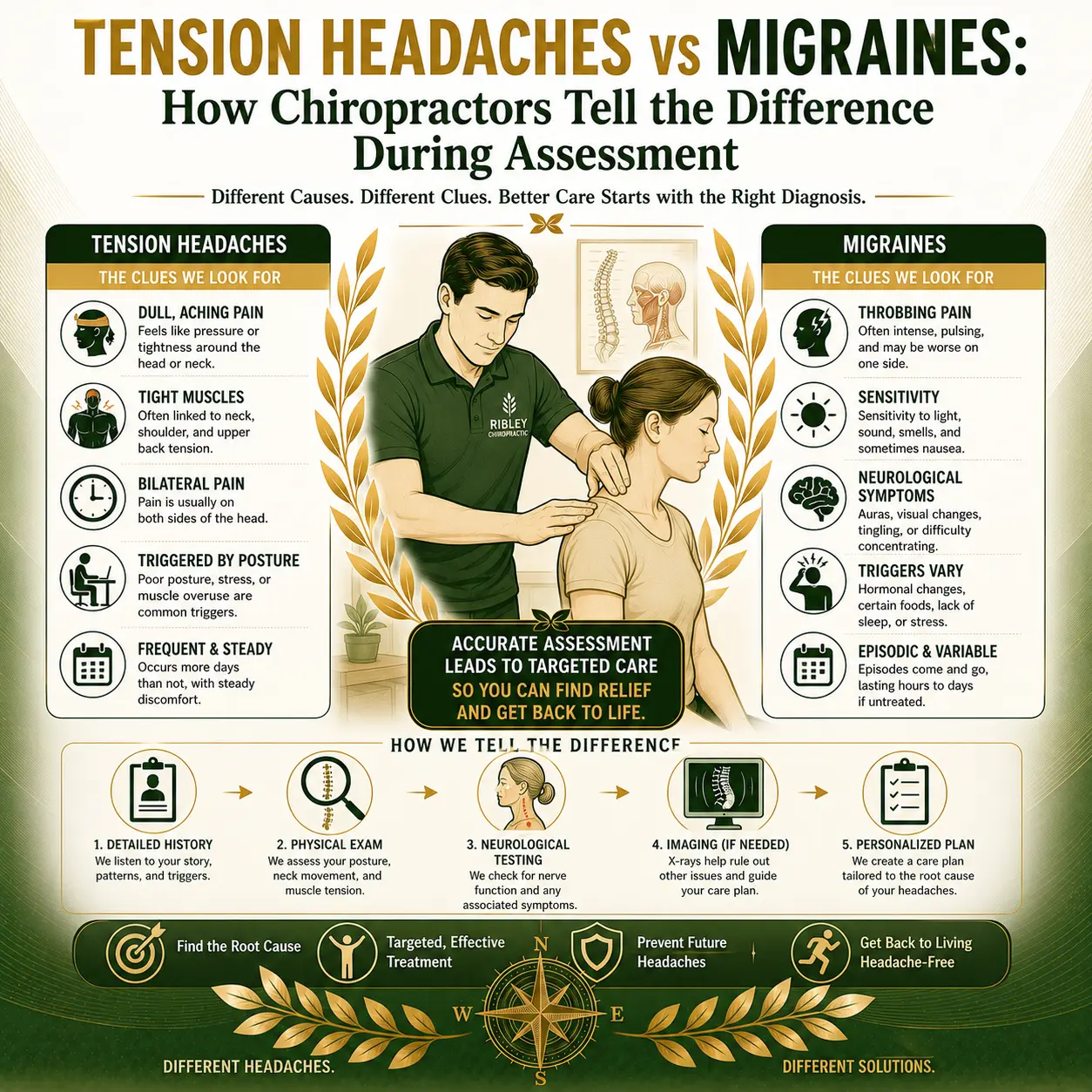
Tension Headaches vs Migraines: How Chiropractors Tell the Difference During Assessment
Headaches are common, but they are not all the same. One person may feel a steady band of pressure around the forehead after working at a computer all day. Another may experience throbbing pain, nausea, and sensitivity to light, making it difficult to remain at work or complete normal household tasks.
These symptoms may point toward a tension-type headache or migraine, but the difference is not always obvious. Some headaches share characteristics, and a person can experience more than one type of headache. Neck stiffness may occur with both tension headaches and migraines. Stress may contribute to either condition. Even pain on one side of the head, which is commonly associated with migraine, does not automatically confirm a migraine diagnosis.
That is why a responsible chiropractic headache assessment involves more than asking where the pain is located. The chiropractor reviews the history of each episode, identifies associated symptoms, examines the neck and nervous system, looks for musculoskeletal contributors, and screens for warning signs that require medical evaluation.
At Ribley Family Chiropractic in Woodstock, Georgia, headache assessments are designed to determine what may be contributing to a patient’s symptoms, whether conservative chiropractic care is appropriate, and whether another healthcare provider should be involved. Ribley Chiropractic serves patients throughout Woodstock, Towne Lake, and North Metro Atlanta with chiropractic care, active therapies, massage therapy, and nutritional guidance.
Why the Difference Between a Tension Headache and Migraine Matters
Correctly identifying the likely headache pattern helps guide the next step in care. A tension-type headache associated with neck stiffness, muscle tenderness, prolonged sitting, or restricted cervical movement may require a different management approach than a migraine involving nausea, light sensitivity, and activity-related worsening.
The distinction also matters because headaches can have causes that fall outside the musculoskeletal system. A chiropractor needs to determine whether the symptoms resemble a common primary headache disorder, appear related to a neck problem, or suggest a condition requiring prompt medical attention.
Tension-type headaches and migraines are considered primary headache disorders. This means the headache itself is the main disorder rather than a symptom directly caused by another identified condition. Secondary headaches, by comparison, may be associated with trauma, infection, medication overuse, vascular problems, eye disorders, or other medical conditions.
A chiropractic assessment does not begin with the assumption that every headache comes from spinal alignment or neck tension. Instead, the chiropractor gathers enough information to identify the most likely pattern, evaluate possible mechanical contributors, and recognize situations in which treatment should be modified, postponed, or referred.
What Does a Tension Headache Usually Feel Like?
Tension-type headaches are commonly described as pressure, tightness, heaviness, or a squeezing sensation. Some patients say it feels as though a tight band is wrapped around their forehead. Others feel pressure at the temples, behind the eyes, at the base of the skull, or across both sides of the head.
According to the International Classification of Headache Disorders, a frequent episodic tension-type headache typically has a pressing or tightening quality rather than a pulsating quality. It is usually mild to moderate, often affects both sides of the head, and does not become substantially worse during routine physical activity such as walking or climbing stairs. Nausea and vomiting are generally absent, although either light sensitivity or sound sensitivity may occur.
A tension-type headache may last from 30 minutes to several days. Some people continue with their normal activities despite the discomfort, although concentration and productivity may suffer. The pain may become more noticeable toward the end of a workday, after a stressful event, or after spending several hours in one position.
People with tension-type headaches may also report tenderness in the muscles around the head, neck, jaw, and shoulders. Pericranial tenderness—the sensitivity of muscles and tissues surrounding the skull—is a common examination finding in tension-type headache presentations. However, tenderness alone does not prove which headache disorder is present. It must be considered alongside the full symptom history.
Common factors reported around tension-type headache episodes may include poor sleep, emotional stress, jaw clenching, skipped meals, prolonged screen use, sustained neck positions, and muscle fatigue. These factors are not universal causes, and their presence does not automatically establish a diagnosis. They are clues that help the chiropractor understand when the headaches occur and what may influence them.
What Does a Migraine Usually Feel Like?
Migraine is more than a severe headache. It is a neurological disorder that can produce head pain along with sensory, digestive, visual, and cognitive symptoms.
A typical migraine without aura lasts between four and 72 hours when untreated or unsuccessfully treated. The pain often has a pulsating or throbbing quality, may be moderate to severe, and frequently becomes worse during routine movement or physical activity. The pain can occur on one side of the head, although some migraines affect both sides.
During a migraine, a person may experience nausea, vomiting, sensitivity to light, sensitivity to sound, or a combination of these symptoms. Some patients want to lie down in a quiet, dark room because normal light, conversation, television, or movement becomes difficult to tolerate. These features are central to the internationally recognized criteria used to identify migraine without aura.
Migraine attacks may also involve symptoms before or after the main headache. A person might notice fatigue, difficulty concentrating, mood changes, food cravings, neck discomfort, or frequent yawning before the head pain begins. After the pain improves, the person may feel drained, mentally foggy, or sensitive to movement.
Migraine With Aura
Some people experience migraine with aura. Aura refers to temporary neurological symptoms that usually develop before or around the beginning of the headache.
Visual aura may include flashing lights, shimmering lines, blind spots, zigzag patterns, or other vision changes. Other forms of aura can involve tingling, numbness, or temporary difficulty with speech.
New neurological symptoms should never be casually assumed to be a familiar migraine aura, especially when they are occurring for the first time, lasting longer than expected, or presenting differently from previous episodes. Sudden weakness, facial drooping, speech difficulty, loss of coordination, confusion, or severe headache may indicate a medical emergency rather than an ordinary migraine attack.
The Centers for Disease Control and Prevention identifies sudden numbness or weakness, trouble speaking, sudden vision problems, loss of balance, and a sudden severe headache with no known cause as possible stroke symptoms requiring an immediate 911 call.
A Quick Comparison of Common Headache Features
Although no single symptom can always distinguish the two conditions, chiropractors often compare several characteristics during the initial interview:
- Tension-type headache pain is commonly pressing, tightening, or steady, while migraine pain is often pulsating or throbbing.
- Tension-type headaches frequently affect both sides of the head, while migraines may be one-sided or bilateral.
- Routine activity usually does not significantly aggravate a tension-type headache, while movement often worsens a migraine.
- Nausea and vomiting are generally absent with tension-type headaches but may occur during migraine.
- A person with a migraine may experience both light and sound sensitivity, while a tension-type headache generally involves no more than one of those symptoms.
- Migraine pain is more likely to interrupt normal activities or cause the patient to seek a dark, quiet environment.
- Muscle tenderness and neck tension may be present with a tension-type headache, but they can also accompany migraine.
- Aura may occur with certain migraines but is not a typical feature of tension-type headache.
These patterns guide the assessment, but they are not a substitute for a complete clinical evaluation. A mild migraine can sometimes resemble a tension-type headache, and people with frequent headaches may experience both disorders. The International Headache Society specifically notes that tension-type headaches and migraines may coexist and that a headache diary can help distinguish the episodes.
How a Chiropractor Begins the Headache Assessment
The most valuable part of a headache assessment is often the conversation before the physical examination. The chiropractor needs to understand what happens before, during, and after each episode.
Instead of asking only, “Where does it hurt?” the chiropractor may ask the patient to describe the entire headache experience. Small details can change the clinical picture.
Important questions may include:
- When did the headaches first begin?
- Did the current pattern begin suddenly or gradually?
- How many headache days occur during an average month?
- How long does an untreated headache typically last?
- Is the pain pressing, burning, stabbing, aching, or throbbing?
- Does the pain affect one side or both sides?
- Does walking, bending, climbing stairs, or exercising worsen it?
- Are nausea, vomiting, light sensitivity, or sound sensitivity present?
- Are there visual changes, numbness, speech problems, or other aura-like symptoms?
- Is the headache associated with neck movement or a specific posture?
- Did the headaches begin after an accident, fall, sports injury, or other trauma?
- Which medications are being used, and how frequently are they taken?
A person may initially describe every episode as a “stress headache.” After a more detailed discussion, the chiropractor may learn that some episodes are mild and pressure-like, while others involve throbbing pain, nausea, and light sensitivity. That information may suggest that the patient experiences both tension-type headaches and migraines rather than one single condition.
Headache Frequency Is an Important Clue
The number of headache days per month helps determine how the condition should be classified and managed.
An occasional tension-type headache has different implications from a headache occurring several days each week. Frequent or daily headaches raise additional questions about sleep, stress, caffeine, medication use, previous injuries, blood pressure, neurological symptoms, and other health factors.
Medication use is especially important. People with frequent headaches may repeatedly use over-the-counter or prescription medications. In some cases, frequent use of acute headache medication can contribute to medication-overuse headache. A chiropractor does not independently instruct a patient to stop prescribed medication. Instead, concerning medication patterns should be discussed with the prescribing physician or another qualified medical provider.
Tracking frequency also creates a baseline. If conservative care is appropriate, progress should be measured by more than the patient’s pain level on one particular day. Useful outcomes may include fewer headache days, shorter episodes, less activity disruption, improved neck movement, better sleep, and reduced need to cancel work or personal plans.
Why Headache Location Is Not Enough
Many patients assume that pain on both sides means tension headache and pain on one side means migraine. Although those patterns are common, they are not absolute.
Migraine can affect both sides of the head. Tension-type headache can occasionally feel more prominent on one side. Pain near the base of the skull may come from tense muscles, irritated joints, migraine-related neck symptoms, or a cervicogenic headache. Facial or eye pain may also overlap with several headache conditions.
The chiropractor therefore evaluates location together with pain quality, duration, activity sensitivity, associated symptoms, episode frequency, and examination findings.
A diagnosis based only on headache location risks missing important information. Two patients may point to the same area near the temple but describe completely different experiences. One may have mild, steady pressure after long hours at a desk. The other may have disabling throbbing pain, nausea, and severe light sensitivity lasting an entire day.
How Neck Symptoms Are Evaluated
Neck pain is common among people with headaches, but the presence of neck discomfort does not automatically prove that the neck is the primary cause.
Migraine can produce neck pain or stiffness as part of the attack. A person may also tense the neck and shoulder muscles in response to headache pain. Conversely, certain headaches may be influenced by cervical joint dysfunction, reduced neck mobility, muscle irritation, or a previous neck injury.
During the physical examination, the chiropractor may assess cervical flexion, extension, rotation, and side bending. The doctor observes whether the movement is limited, painful, guarded, or capable of reproducing the patient’s familiar headache.
The chiropractor may also examine the muscles at the base of the skull, along the neck, around the jaw, and across the shoulders. The purpose is not simply to find a sore spot. The examiner looks for findings that match the patient’s history and symptom pattern.
For example, limited neck rotation that consistently reproduces familiar head pain may be clinically relevant. General muscle tenderness that does not reproduce the patient’s headache may be less meaningful. Findings must be interpreted as a group rather than used in isolation.
Could It Be a Cervicogenic Headache?
Cervicogenic headache is a secondary headache attributed to a disorder or lesion within the cervical spine or the soft tissues of the neck. It is usually, but not always, accompanied by neck pain.
The International Classification of Headache Disorders notes that supporting features can include reduced cervical range of motion and significant worsening of the headache during provocative neck maneuvers. Evidence should also show a relationship between the cervical condition and the headache rather than relying only on an imaging finding.
Cervicogenic headache can overlap with migraine and tension-type headache symptoms. A patient may have neck pain, one-sided head pain, and sensitivity around the upper neck. That does not mean the chiropractor should immediately label the condition cervicogenic.
Imaging changes in the neck are also common in people without headaches. An X-ray showing age-related degeneration does not automatically establish that the degeneration is causing the patient’s head pain. The history, movement findings, neurological examination, and response to appropriate care all contribute to the clinical interpretation.
What the Physical Examination May Include
The exact examination depends on the patient’s symptoms, health history, age, previous injuries, and reported warning signs. Not everyone receives the same tests.
A headache-focused chiropractic examination may include observation of posture and movement, cervical range-of-motion testing, muscle and joint palpation, orthopedic procedures, and a neurological screen.
When indicated, the neurological portion may include checking strength, reflexes, sensation, eye movements, facial symmetry, coordination, balance, or other functions. These procedures help determine whether the symptoms appear compatible with conservative musculoskeletal care or whether medical investigation is needed.
The chiropractor may also evaluate the shoulders, upper back, jaw, and movement habits. For example, restricted upper-back mobility, prolonged forward-head positioning, jaw clenching, or shoulder muscle fatigue may contribute to a patient’s discomfort without being the sole cause of the headache.
Responsible assessment avoids reducing the condition to one finding, such as posture, muscle tightness, or a single restricted joint. Headaches are often influenced by several factors, and the clinical plan should reflect that complexity.
The Role of a Headache Diary
A headache diary is one of the most practical tools for separating tension-type headaches from migraines.
Memory is not always reliable when headaches occur repeatedly. Patients may remember the worst attacks but forget milder episodes. They may also underestimate how often they use medication or how frequently symptoms interfere with normal activities.
A useful headache diary records:
- The date and approximate starting time
- How long the episode lasted
- Pain location and pain quality
- Pain intensity
- Nausea, light sensitivity, sound sensitivity, or aura
- Neck pain or restricted movement
- Activities occurring before the headache
- Sleep, meals, hydration, caffeine, and stress changes
- Medication taken and the result
- Whether the headache stopped work, exercise, driving, or other activities
After several weeks, patterns may become clearer. The diary may show one type of mild pressure headache associated with work posture and a separate type of disabling episode involving nausea and light sensitivity. It may reveal headaches that consistently occur after poor sleep, long gaps between meals, certain activities, or frequent medication use.
The information can help the chiropractor make a better assessment and can also be shared with the patient’s primary care physician, neurologist, or other healthcare provider.
Red Flags That Change the Assessment
Before considering treatment, the chiropractor must look for features suggesting that the headache may require urgent or specialized medical evaluation.
The American College of Radiology identifies several headache red flags, including sudden severe onset, increasing frequency or severity, fever, neurological deficits, a history of cancer or immunocompromise, onset after age 50, post-traumatic onset, and new headache patterns during pregnancy or the period after delivery.
A patient should seek immediate medical attention for symptoms such as:
- A sudden, explosive headache reaching maximum intensity rapidly
- A severe headache unlike any previous episode
- New weakness, facial drooping, confusion, or speech difficulty
- New loss of balance, coordination, or consciousness
- Sudden vision loss or major visual changes
- Headache with fever, severe neck stiffness, or unexplained illness
- Headache following significant head or neck trauma
- A new severe headache during pregnancy or after giving birth
- A rapidly worsening pattern or major change from previous headaches
These symptoms do not confirm a particular emergency by themselves, but they justify prompt medical investigation. An adjustment should not be used as a trial treatment when the history suggests a potentially serious condition.
At Ribley Chiropractic, the assessment process includes screening for symptoms that fall outside routine conservative care. When necessary, the appropriate decision may be referral to a primary care physician, neurologist, urgent care center, emergency department, or another provider.
Does Every Headache Patient Need Imaging?
Most patients with a familiar headache pattern and no warning signs do not automatically need an X-ray, CT scan, or MRI.
Imaging decisions should be based on the clinical history, examination findings, trauma history, neurological status, and whether the results would change the care plan. Brain imaging may be appropriate when red flags are present, but it is generally not ordered simply because someone has an uncomplicated pattern consistent with a primary tension-type headache or migraine.
Spinal X-rays also cannot diagnose migraine or tension-type headache. They may provide information about bones, previous injuries, alignment, or certain degenerative changes, but those findings must be interpreted carefully. Structural changes do not always explain symptoms.
If the chiropractor identifies a reason for neurological imaging or another test that is not available in the office, the patient may be referred to an appropriate medical provider.
What Happens When the Assessment Suggests Migraine?
When the history strongly resembles migraine, the chiropractor considers the patient’s existing diagnosis, treatment plan, frequency of attacks, neurological symptoms, medications, and whether the condition is stable.
A patient with an established migraine diagnosis may receive conservative care for associated neck pain, stiffness, mobility limitations, or muscular tension when the examination supports it. Chiropractic care should not be presented as a guaranteed cure for a neurological disorder.
A patient with new, changing, unusually severe, or poorly controlled migraine-like symptoms may need medical evaluation. Co-management can be especially important when attacks are frequent, medications are no longer effective, neurological symptoms are changing, or the headaches significantly interfere with daily life.
The National Center for Complementary and Integrative Health reports that research on spinal manipulation for headaches has produced mixed or contradictory findings. It also notes that temporary soreness, discomfort, tiredness, or headache may occur after spinal manipulation and that rare serious events have been reported following cervical manipulation, although causation is not always clear. These uncertainties make screening, informed consent, appropriate technique selection, and communication with other healthcare providers important.
What Happens When the Assessment Suggests a Musculoskeletal Component?
When the examination identifies neck stiffness, restricted movement, muscle tension, postural strain, or another mechanical factor that appears related to the patient’s symptoms, the chiropractor may recommend a conservative care plan.
Depending on the individual, the plan may include chiropractic adjustments, gentler joint mobilization, soft-tissue treatment, active therapy, massage therapy, mobility exercises, strengthening, or ergonomic guidance. Not every patient needs a forceful neck adjustment, and treatment should be adapted to the patient’s history, comfort level, preferences, and clinical findings.
At Ribley Family Chiropractic, headache care may be incorporated into a broader plan that addresses spinal movement, muscle tension, daily habits, and other relevant health factors. The office also provides active therapies, massage therapy, and nutritional support when appropriate.
Progress should be reassessed. If headache frequency, intensity, function, or neck mobility does not improve as expected, the working diagnosis and care plan should be reconsidered. Continuing the same treatment indefinitely without meaningful improvement is not an appropriate substitute for reassessment.
How Patients Can Prepare for a Headache Assessment
Patients can help make the assessment more accurate by bringing specific information rather than relying on a general description such as “I get headaches all the time.”
Before the appointment, write down how often the headaches occur, how long they last, where the pain begins, what the pain feels like, and which symptoms accompany it. Bring a list of prescription drugs, over-the-counter medications, supplements, and previous headache treatments.
Medical records may also be useful, particularly when the patient has previously seen a neurologist, completed imaging, visited an emergency department, or received treatment after a head or neck injury.
Patients should tell the chiropractor about cardiovascular conditions, blood-clotting disorders, blood-thinning medication, previous stroke or transient ischemic attack, osteoporosis, cancer, recent infection, pregnancy, surgeries, and significant trauma. These factors may change the examination, technique selection, or need for referral.
It is also important to describe any fear or concern about neck treatment. Informed consent means patients should understand what is being recommended, why it is being considered, what alternatives exist, and what risks may be involved. A patient does not have to agree to a particular adjustment technique.
Questions to Ask Your Chiropractor
A good headache assessment should leave the patient with a clearer understanding of the findings and next steps.
Consider asking:
- Which features suggest tension-type headache, migraine, or another headache pattern?
- Did the examination identify a musculoskeletal contributor?
- Were there any neurological findings or warning signs?
- Do I need to see my primary care physician or a neurologist?
- Is imaging necessary, and how would it change the plan?
- Which treatment options are being recommended?
- Are gentler alternatives available?
- How will we measure whether care is helping?
- When will my symptoms and progress be reassessed?
- What changes should prompt immediate medical attention?
Clear answers allow patients to make informed decisions and recognize the difference between a thoughtful care plan and a one-size-fits-all recommendation.
Frequently Asked Questions
Can neck tension trigger a migraine?
Neck discomfort and migraine frequently occur together, but the relationship can vary. Neck tension may contribute to symptoms for some patients, while for others, neck pain may be part of the migraine attack itself. An assessment looks at timing, movement, symptom reproduction, neurological features, and the overall headache pattern rather than assuming the neck is always the cause.
Can a tension headache be severe?
Tension-type headaches are usually mild to moderate, but frequent or chronic episodes can still be highly disruptive. A severe headache, rapidly worsening headache, or headache that is different from the patient’s usual pattern should receive careful evaluation.
Can someone have tension headaches and migraines?
Yes. A person can experience both headache types. The episodes may require different management strategies, which is why documenting the features of each headache in a diary is useful.
Does throbbing pain always mean migraine?
No. Throbbing pain is a common migraine feature, but one characteristic does not establish the diagnosis. The chiropractor also considers duration, location, activity sensitivity, nausea, sensory sensitivity, aura, frequency, and other symptoms.
Should I see a chiropractor or neurologist for headaches?
The appropriate provider depends on the symptoms. A chiropractor may evaluate musculoskeletal factors and screen for neurological or medical concerns. A neurologist or primary care physician may be appropriate for new migraines, changing neurological symptoms, frequent disabling attacks, medication management, uncertain diagnoses, or symptoms that do not respond as expected.
Will a chiropractor adjust my neck during the first visit?
Not automatically. A responsible chiropractor completes the history and examination before recommending treatment. If an adjustment is appropriate, the technique should be explained and adapted to the patient’s health history and preferences. Treatment may be delayed when imaging, medical clearance, or referral is needed.
Conclusion
Tension-type headaches and migraines can share symptoms, but they often differ in pain quality, severity, duration, sensitivity to activity, and associated symptoms.
Tension-type headaches are commonly pressing or tightening, affect both sides of the head, and do not usually worsen with routine activity. Migraines are more likely to produce throbbing or pulsating pain, nausea, light and sound sensitivity, and symptoms that become worse with movement. These are useful patterns, but they are not rigid rules.
During a chiropractic assessment, the doctor reviews the timing and characteristics of each episode, examines the neck and surrounding muscles, evaluates movement, performs neurological screening when indicated, and looks for warning signs. The goal is not merely to choose an adjustment. It is to determine whether the symptoms suggest a common headache disorder, whether musculoskeletal factors may be involved, and whether medical referral is necessary.
At Ribley Family Chiropractic in Woodstock, Georgia, headache care begins with listening and evaluating the full clinical picture. When conservative care is appropriate, recommendations may include chiropractic techniques, active therapy, massage therapy, exercises, and practical guidance based on the patient’s needs. When symptoms require medical investigation, referral or coordinated care is the responsible next step.
If headaches are interfering with work, sleep, exercise, driving, or family activities, schedule an assessment with Ribley Family Chiropractic to better understand your symptoms and determine which care options may be appropriate.
This article is intended for general education and does not replace individualized medical advice. Call 911 for a sudden severe headache or a headache accompanied by weakness, facial drooping, confusion, speech difficulty, major vision changes, loss of coordination, fainting, or other emergency symptoms.