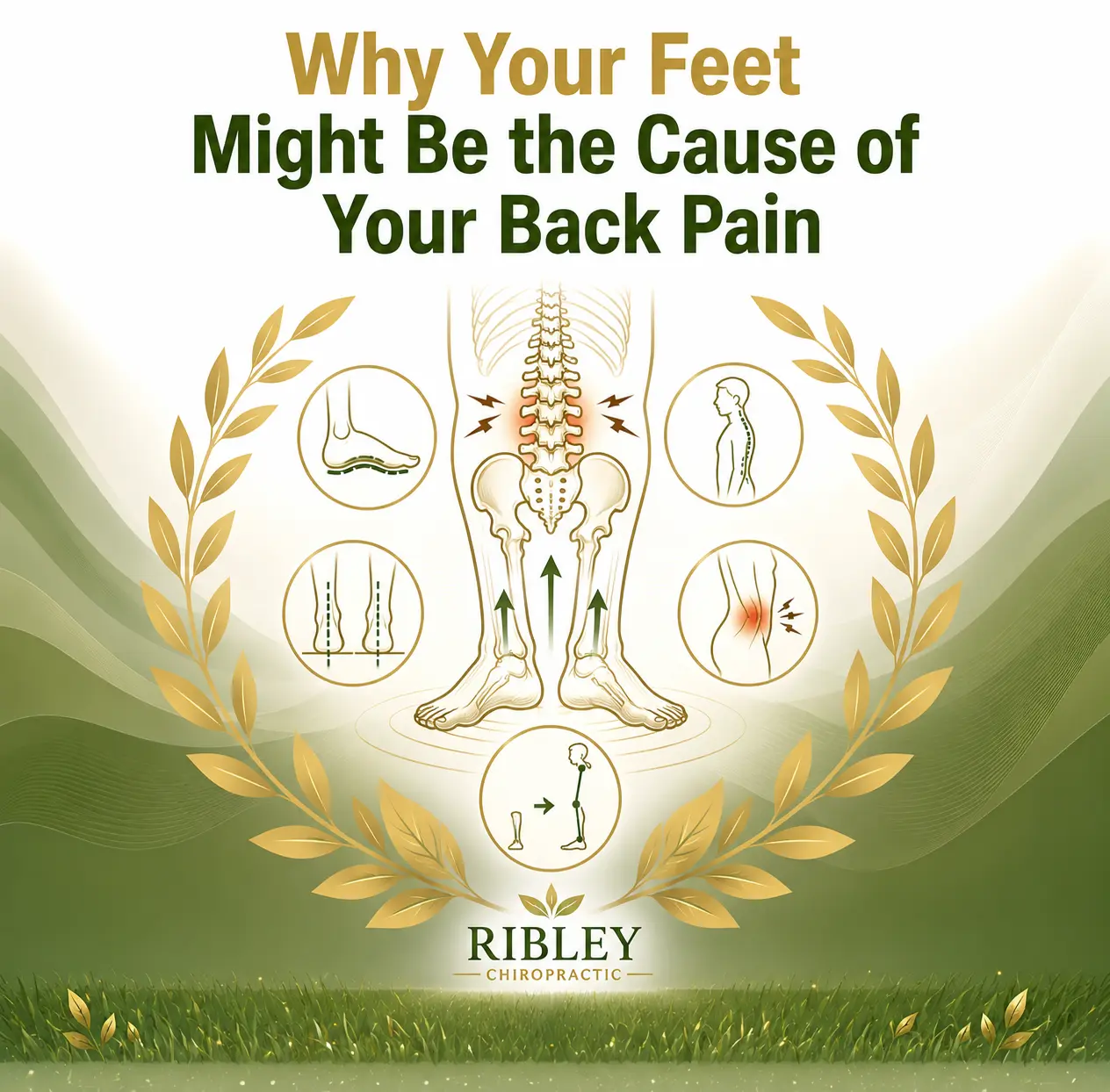
Why Your Feet Might Be the Cause of Your Back Pain
Most people who walk into a chiropractic office for back pain have already tried a dozen things — stretching, massage, heat packs, changing their mattress. What they haven’t considered is looking down. Your feet are the foundation of your entire musculoskeletal system, and when that foundation is off, everything built on top of it eventually pays the price — including your spine.
At Ribley Family Chiropractic, we regularly see patients who’ve been managing back pain for months or even years without any lasting relief, only to discover that the structural root of the problem starts at ground level. Understanding the connection between your feet and your back doesn’t just explain why the pain is there — it opens the door to solutions that actually address the cause rather than the symptom.
Your Body Works as a Kinetic Chain
To understand how your feet influence your back, you first need to understand how your body moves as a connected system. Biomechanists and physical therapists refer to this as the kinetic chain — the idea that every joint and segment of your body is linked, and a problem at one link affects every link above and below it.
Your feet are at the very bottom of that chain. Every time you take a step, your feet absorb the shock of your body weight making contact with the ground. They distribute that load, stabilize your balance, and propel you forward. When they do this job properly, the forces of walking and standing travel through your body in a controlled, predictable way. When they don’t, those forces go somewhere they’re not supposed to go — and the joints, muscles, and connective tissue above the foot start compensating.
That compensation doesn’t stop at your ankle. It travels upward through your knee, into your hip, across your pelvis, and straight into your lumbar spine. Day after day, step after step, those compensatory forces accumulate. What starts as a subtle mechanical inefficiency at foot level becomes a chronic pain pattern in your low back — often without any obvious injury or event to explain it.
Think of it the way you’d think about a house with a crooked foundation. The walls and roof don’t stay straight — they shift to accommodate the imbalance below. Your spine does the same thing when your feet aren’t providing the stable base they’re designed to provide.
How Flat Feet Contribute to Back Pain
Flat feet — also called overpronation or fallen arches — are one of the most common foot mechanics issues that drive back pain, and one of the most commonly overlooked. When you have flat feet, the arch of your foot collapses inward with each step rather than maintaining its natural curve. That inward rolling motion (pronation) is normal to a degree, but when it becomes excessive, it sets off a chain reaction that works its way directly up to your lumbar spine.
Here’s what that chain reaction looks like in practical terms. When your foot rolls too far inward, your lower leg follows, rotating inward as well. That rotation travels up to your knee, which begins to track inward. Your hip then compensates with its own inward rotation, which tilts your pelvis forward. That forward pelvic tilt increases the curve of your lumbar spine — a condition called hyperlordosis — and places chronic compressive stress on the muscles, joints, and discs of your lower back.
Research supports this connection directly. Studies show that people with flat feet are 4.5 times more likely to experience chronic lower back pain compared to those with normal arch function. That’s a striking statistic, and it reflects just how much mechanical influence your foot architecture has over the health of your spine.
The pain pattern associated with flat-foot-driven back problems is typically felt as a diffuse ache in the lower lumbar region, often accompanied by fatigue in the legs and hips after prolonged standing or walking. Patients frequently describe it as a pain that builds throughout the day and eases with rest — a pattern that reflects the cumulative stress model playing out in real time.
The Problem With High Arches
While flat feet get most of the attention, high arches create their own set of back pain problems through a different mechanism. A high-arched foot is structurally rigid. It doesn’t flex and absorb shock the way a foot with a normal or lower arch does, which means the impact energy generated with every step doesn’t dissipate at the foot level.
That unabsorbed shock has to go somewhere. It travels upward through the legs and into the lumbar spine, where the vertebrae, discs, and surrounding tissue are forced to absorb forces they weren’t designed to handle. Over time, this leads to increased spinal compression and accelerated wear on the lumbar joints and intervertebral discs.
People with high arches also tend to bear weight unevenly — putting more load on the outer edge of the foot — which creates lateral instability. That instability produces compensatory muscle tension up the outer chain of the leg and into the hip and lower back. The result is chronic muscular tightness on one or both sides of the lumbar spine, which limits mobility and generates persistent aching pain.
What Both Extremes Have in Common
Whether your arches are too low or too high, the underlying problem is the same: your foot isn’t managing ground forces the way it should, and your spine is compensating. The specific pattern of pain and dysfunction differs, but the biomechanical principle connecting foot mechanics to spinal health is consistent across both ends of the arch spectrum.
Gait Abnormalities and Their Upstream Effects
Your gait — the pattern of how you walk — is one of the most telling windows into how your feet are affecting your spine. Most people never think about how they walk unless something is causing obvious pain, but subtle gait deviations that have developed over years are often silent drivers of chronic back problems.
Overpronation and underpronation both alter your gait pattern in ways that create asymmetrical loading across your pelvis and lumbar spine. When one foot rolls differently than the other, your pelvis shifts slightly with each step to compensate. That asymmetric pelvic motion creates a rotational stress on the sacroiliac joint — the joint where your spine connects to your pelvis — and on the lumbar vertebrae themselves. Repeated thousands of times per day, this stress is a direct contributor to sacroiliac joint dysfunction and lumbar muscle strain.
Even minor foot problems that change the way you walk can set this process in motion. A bunion, hammertoe, plantar fasciitis, or even a persistent blister changes how you load your foot, which changes your stride, which eventually strains your back. Patients dealing with plantar fasciitis, for example, often unconsciously shift weight to the outer edge of the affected foot or shorten their stride to avoid heel contact — both of which alter pelvic mechanics and create secondary back pain.
Leg Length Discrepancy Caused by Foot Mechanics
One of the more surprising ways foot mechanics drive back pain is through functional leg length discrepancy — a condition where the two legs effectively function at different lengths, not because of any bone length difference, but because of how the feet are positioned and how the joints above them are aligned.
When one foot overpronates more than the other, the arch on that side collapses further, effectively shortening that leg’s functional length. The pelvis then tilts to compensate, dropping lower on the side of the shorter functional leg. That pelvic tilt creates a lateral curve in the lumbar spine — a functional scoliosis — that puts uneven compressive forces on the lumbar discs and facet joints.
This kind of asymmetric loading is particularly insidious because it’s always present. Every time you stand, walk, or carry any weight, the pelvic tilt and resultant spinal curvature are working against your lumbar spine. Without addressing the foot mechanics creating the functional length discrepancy, the spinal consequences will persist regardless of how much manual therapy or exercise you do.
How Footwear Makes Things Worse
Beyond the structural mechanics of your feet themselves, what you put on them has a significant effect on your spinal health. Footwear choices are something most people make based on style, price, or comfort in the moment — rarely based on the biomechanical support they provide.
High heels are the most well-documented footwear contributor to back pain. They shift your center of gravity forward, forcing your lumbar spine into an exaggerated inward curve to maintain an upright posture. That curve increases compressive loading on the posterior elements of the lumbar spine — the facet joints and the supporting ligaments — and causes the hip flexors and lumbar erectors to work overtime to keep you balanced. Worn regularly, this creates chronic lumbar strain and accelerates degenerative changes in the lower back.
Flat, unsupportive shoes present a different problem. Without adequate arch support or cushioning, the foot absorbs more impact than it should with each step, and without proper arch support, overpronation goes unchecked. Worn-down soles create uneven surfaces underfoot that introduce new asymmetries into the gait pattern. Even footwear that was once supportive becomes a contributor to back pain over time as its structural integrity breaks down.
The footwear conversation is one that comes up regularly in chiropractic care because it’s one of the most actionable lifestyle factors a patient can change immediately. Transitioning to well-supported footwear — or adding custom or over-the-counter orthotics — often produces noticeable improvement in low back symptoms surprisingly quickly.
Orthotics and Chiropractic Care: A Combined Approach
When foot mechanics are contributing to back pain, addressing the spine alone will only take you so far. Chiropractic adjustments can restore proper alignment in the lumbar spine, reduce nerve irritation, and improve joint mobility — but if the mechanical forces driving the misalignment are still coming up from the feet with every step, the spine will drift back out of alignment more quickly than it should.
This is why a combined approach — addressing the spine through chiropractic care while simultaneously supporting the foot mechanics through orthotics or footwear modifications — produces more durable results than either intervention alone. Orthotics work by providing the arch and motion control that your feet aren’t providing naturally, which corrects the chain reaction before it reaches your lumbar spine.
Custom orthotics are molded to the individual’s specific foot structure and gait pattern, making them the most precise option. Over-the-counter orthotics are a more accessible starting point and can be effective for milder cases of overpronation or inadequate arch support. The right choice depends on the severity of the foot mechanics issue and the degree to which it’s contributing to the patient’s back symptoms.
At Ribley Family Chiropractic, evaluating the full kinetic chain — including how your feet and gait mechanics may be influencing your spine — is part of how we approach back pain that hasn’t responded to conventional treatment. You can’t build lasting spinal health on a compromised foundation.
Signs Your Feet May Be Driving Your Back Pain
Not everyone with back pain has a foot mechanics problem at the root of it, but there are several patterns that suggest the feet deserve a closer look:
- Back pain that worsens after prolonged standing or walking, rather than after specific movements or activities
- Uneven shoe wear — if your soles wear down more on the inside or outside edge, your foot mechanics are off
- Flat feet or visibly collapsed arches when you stand
- A history of plantar fasciitis, bunions, or other chronic foot conditions alongside back pain
- Back pain that has never had a clear injury or onset event to explain it
If any of these patterns sound familiar, the connection between your feet and your spine is worth exploring directly. A structural evaluation that looks at both your spinal alignment and your foot mechanics gives a much more complete picture of why the pain is there and what will actually address it.
Conclusion
Your back pain may have nothing to do with your back — at least not at its origin. When the foundation your body stands on isn’t structurally sound, the consequences travel upward through every joint in your lower body before landing in your lumbar spine. Flat feet, high arches, overpronation, gait asymmetries, and poor footwear choices are all legitimate drivers of chronic back pain that go unaddressed when treatment focuses exclusively on the site of the pain rather than the cause of it.
At Ribley Family Chiropractic, we take a whole-body approach to back pain because that’s what back pain requires. If you’ve been managing recurring or persistent low back pain without finding real answers, let us take a closer look at the full picture — starting, if necessary, from the ground up. Contact us today to schedule a comprehensive evaluation and find out what’s actually driving your pain.