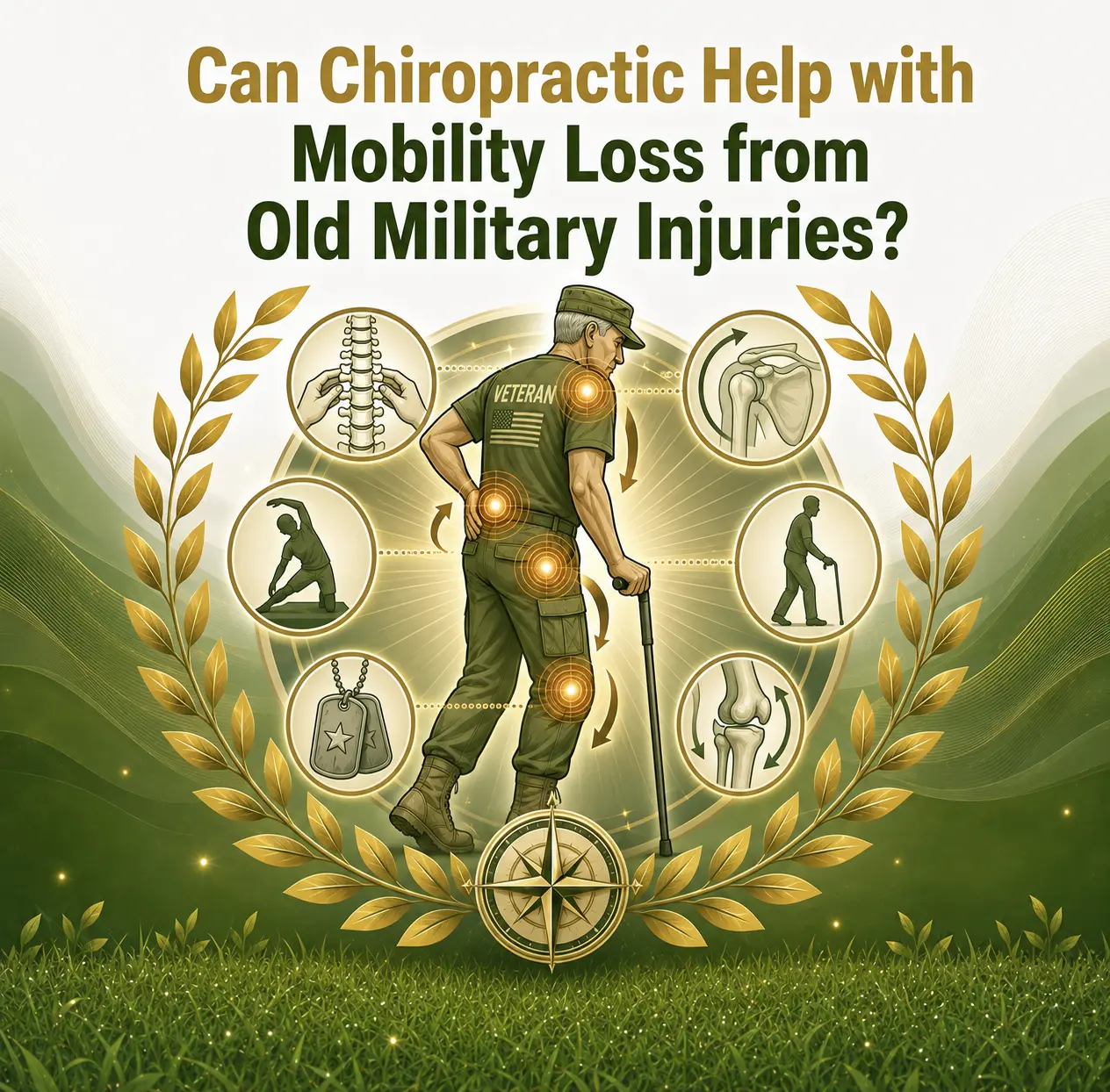
Can Chiropractic Help with Mobility Loss from Old Military Injuries?
If you’ve been living with stiffness, limited range of motion, or nagging pain from an old military injury, you’ve probably been told at some point to “just manage it.” Maybe you’ve tried medications, physical therapy, or simply learned to work around the limitation. But for many veterans in Woodstock and across Illinois, mobility loss from service-related injuries doesn’t have to be a permanent sentence. Chiropractic care has become a recognized, evidence-supported approach to restoring functional movement — and it’s helping veterans reclaim the physical independence they thought they’d lost for good.
At Ribley Family Chiropractic, we see veterans regularly who come in skeptical and leave with real results. This article is for anyone who’s ever wondered whether their old military injury could still be addressed — and whether chiropractic might be part of that answer.
Why Military Injuries Lead to Long-Term Mobility Loss
Military service puts the body through extremes that most civilian occupations never approach. Carrying heavy loads for extended periods, rapid physical training, combat-related trauma, repetitive strain from equipment and gear, and the cumulative effect of years of high-impact activity all leave marks on the musculoskeletal system. The spine, hips, knees, and shoulders bear the heaviest burden, and when injuries in these areas aren’t fully rehabilitated — or when veterans push through pain because that’s what service demands — the damage compounds over time.
What makes military injuries particularly tricky is the compensation pattern they create. When one part of the body is injured, the surrounding structures adjust to protect it. A knee injury changes how you walk. An altered gait shifts pressure onto the lower back. A lower back problem changes how the pelvis sits, which affects the hips and eventually the neck. Years down the road, veterans often present with mobility restrictions not just at the original injury site, but throughout the entire kinetic chain — and they may not even connect those downstream problems back to that original service-related injury.
This is a well-documented phenomenon in musculoskeletal medicine. The body is remarkably adaptable, but adaptation has a cost. Scar tissue forms around old injuries, reducing flexibility. Joints that have been loaded unevenly develop a restricted range of motion. Muscles that have been chronically overworked or underused lose their functional balance. All of this adds up to the kind of mobility loss that many veterans just accept as “getting older” — when in reality, it’s addressable.
What Chiropractic Actually Does for Mobility
Chiropractic care isn’t just about back cracking or quick adjustments. At its core, it’s a clinical approach to restoring proper biomechanical function throughout the spine and joints. A chiropractor’s goal is to identify where movement is restricted, where alignment is off, and where the nervous system’s ability to communicate with the muscles and joints has been compromised — then address those issues directly with targeted, hands-on treatment.
For veterans dealing with mobility loss from old injuries, the treatment picture typically involves several interconnected elements. Spinal manipulation restores proper joint motion in the vertebral column, which directly affects how the surrounding muscles and nerves function. Joint mobilization applies controlled, low-velocity movement to restricted joints — effective for shoulders, hips, knees, and ankles that have stiffened over years of compensatory movement. Soft tissue work, including myofascial release and trigger point therapy, breaks down scar tissue and adhesions that restrict range of motion and contribute to chronic pain.
Beyond hands-on treatment, a good chiropractor also prescribes corrective exercises to reinforce proper movement patterns and rebuild the muscular support that old injuries have depleted. This active component is what turns short-term relief into long-term functional improvement. Veterans who engage seriously with both the in-office treatment and the home exercise component see the most significant and lasting gains in mobility.
Research backs this up. Studies published in peer-reviewed journals have found spinal manipulation to be effective for low back pain — one of the most common service-related conditions — and chiropractic care has been shown to improve range of motion in patients with chronic musculoskeletal conditions. A particularly meaningful data point for veterans: 65% of veterans treated by chiropractors report significantly less pain, and chiropractic care has been associated with a roughly 32% reduction in opioid use. That second statistic matters enormously given the well-documented risk of opioid dependence among the veteran population.
Common Military Injuries That Respond Well to Chiropractic
Not every condition is the same, and chiropractic is not a universal solution for every injury. But there’s a wide range of service-related conditions where chiropractic care has a strong track record of producing genuine improvement in both pain levels and mobility.
Low Back Injuries and Lumbar Dysfunction
This is the single most common complaint among veterans seeking chiropractic care. Years of load-bearing — heavy packs, body armor, prolonged sitting in vehicles — compress the lumbar spine and contribute to disc degeneration, facet joint dysfunction, and muscle imbalance. Spinal manipulation and targeted lumbar rehabilitation can meaningfully restore mobility and reduce the chronic pain that makes everyday movement difficult.
Cervical Spine Problems from Helmet Use and Impact
Neck strain from helmet weight, vehicle impacts, and deployment-related trauma is extremely common. The cervical spine is particularly vulnerable because it supports the head while also providing a wide range of motion. When old neck injuries go untreated, the resulting stiffness can limit head rotation, contribute to chronic headaches, and even cause radiating symptoms into the shoulders and arms. Chiropractic adjustments and cervical mobilization address the root restriction rather than just managing symptoms.
Shoulder Injuries from Carrying and Combat
Repetitive overhead loading, carrying heavy weapon systems, and trauma-related shoulder injuries can leave veterans with chronically restricted shoulder mobility. Chiropractic care — particularly when combined with soft tissue work — helps restore normal glenohumeral joint mechanics and reduce the muscular compensation patterns that develop around old shoulder injuries.
Hip and Knee Problems from Altered Gait
As mentioned earlier, these often trace back upstream to spinal or pelvis alignment issues. When the pelvis sits unevenly due to a chronic lower back problem, the hips and knees compensate in ways that accelerate wear and restrict movement. Addressing the root spinal dysfunction often produces noticeable downstream improvement in hip and knee mobility as well.
The Challenge of “Old” Injuries
One of the most common questions veterans ask is whether their injury is simply too old to benefit from chiropractic. It’s a fair concern — there’s an instinct to assume that if something has been wrong for twenty years, it’s too late to change it. The reality is more encouraging.
While chronic injuries do present differently than acute ones — more scar tissue, more compensatory patterns, more deeply ingrained movement habits — the body retains a remarkable capacity for adaptation and improvement at any age. The nervous system is plastic, meaning it can reorganize and improve its function in response to treatment. Joints that have been restricted for years can regain a meaningful range of motion when the mechanical barriers to that movement are addressed consistently. It takes longer, requires more patience, and the goal shifts from full restoration to functional improvement — but progress is genuinely possible.
What we look for at Ribley Family Chiropractic is not “can we reverse twenty years of wear?” but rather “what is limiting this person’s movement, and what can we realistically improve?” That honest, individualized assessment is what separates good chiropractic care from a one-size-fits-all approach. Some veterans come in after decades and walk out after several weeks of care with noticeably better range of motion and less pain. Others see more modest gains that still translate into meaningful improvements in their daily lives — being able to turn their head to check traffic, bend down without wincing, or get through a workday without back pain.
What to Expect at Your First Visit
For veterans who haven’t seen a chiropractor before, or who had a poor experience elsewhere, knowing what to expect helps set realistic expectations and reduces the hesitation that keeps people from getting care they need.
Your first visit at Ribley Family Chiropractic starts with a thorough consultation. We want to hear your service history, your injury timeline, what you’ve tried before, and what your current limitations look like in everyday life. This isn’t just background — it directly informs the examination and the treatment plan. After the consultation, we perform a physical and orthopedic examination that assesses your range of motion, posture, spinal alignment, and neurological function. If imaging is warranted, we’ll discuss that with you.
From there, we develop a care plan that’s specific to your injuries, your mobility goals, and your schedule. We’re not going to suggest a treatment plan that doesn’t make clinical sense for your situation. And we’ll be honest with you about what chiropractic can and can’t do — because the veterans we serve deserve straight answers, not overpromises.
VA Coverage for Chiropractic Care
Veterans in Woodstock have real options when it comes to covering chiropractic care through their VA benefits. The VA has included chiropractic services in its standard Medical Benefits Package since 2004. Access typically starts with a referral from your VA primary care provider, and from there, you may be seen at a VA facility that offers chiropractic on-site, or — if that’s not available or accessible — through the VA Community Care program, which allows you to see a local, VA-approved provider like Ribley Family Chiropractic.
For the VA to cover chiropractic care, the condition being treated generally needs to be service-connected — meaning the injury or condition either occurred during service or was aggravated by it. That covers a wide range of the musculoskeletal issues veterans typically present with. In some cases, veterans with non-service-connected conditions may also qualify, depending on their specific coverage tier and eligibility status.
If you’re unsure whether your condition qualifies or how to initiate a referral, reaching out to your VA primary care team is the right first step. Ribley Family Chiropractic is set up to work with VA Community Care patients, so once authorization is in place, getting started is straightforward.
Why Consistent Care Produces the Best Results
One thing worth being honest about: chiropractic care for old military injuries is not a one-visit fix. Chronic mobility restrictions that have developed over years of compensation and scar tissue buildup require consistent, progressive treatment to genuinely shift. The most successful outcomes happen when veterans commit to a structured care plan — showing up for their scheduled appointments, following through with any prescribed home exercises, and giving the treatment time to accumulate results.
The veterans who see the most meaningful improvement are those who approach chiropractic the same way they approached training — with consistency and discipline. Skipping appointments or stopping care at the first sign of improvement before the underlying problem is fully addressed tends to result in setbacks and regression. A good chiropractor will always be transparent about where you are in your care plan and when it’s appropriate to transition to maintenance or discharge.
Chiropractic as Part of a Larger Care Strategy
It’s worth noting that chiropractic works best as part of a coordinated approach to veteran health — not as a standalone solution in isolation. The VA’s whole-health model recognizes this, which is why VA chiropractors are integrated with primary care, rehabilitation, pain management, and other specialty teams. When chiropractic is combined with physical therapy, appropriate exercise, nutritional support, and mental health care where relevant, the outcomes for veterans are consistently better than any single intervention alone.
At Ribley Family Chiropractic, we communicate with your VA care team when you’re a Community Care patient, so your treatment is coordinated and your providers stay informed. We’re part of your healthcare picture, not separate from it. That kind of integration reflects how veteran care should work — comprehensive, connected, and patient-centered.
Conclusion
Mobility loss from old military injuries is real, but it’s not necessarily permanent. Chiropractic care offers veterans a drug-free, non-invasive way to address the underlying mechanical issues driving restricted movement — whether the original injury happened five years ago or thirty. The body retains the capacity to adapt and improve with the right kind of consistent, targeted care.
If you’re a veteran in Woodstock dealing with stiffness, limited range of motion, or chronic pain from a service-related injury, Ribley Family Chiropractic is ready to help. We’ll give you an honest evaluation, a clear plan, and the kind of care you’ve earned through your service. Reach out to schedule your first visit — because your mobility matters, and it’s worth fighting for.